Morocco's rail network radiates from Casablanca, the country's transport hub: fast trains link the main northern cities, comfortable intercity buses fill the gaps, and — for the south, the mountains and the desert — private drivers take over. The right mix depends on your route and pace.
In this guide
Trains, buses and the private car
Casablanca is the centre of the ONCF rail network, which links Tangier, Rabat, Casablanca, Fes, Meknes and Marrakech, including the Al Boraq high-speed line (Tangier–Casablanca in about two hours, Casablanca–Rabat in around 45 minutes). A dedicated airport line runs from CMN to Casa Voyageurs station, where almost every intercity service begins. Trains are the easy, cheap way down the populated north-west spine. Beyond the rail map — Chefchaouen, the Atlas, Ouarzazate, the gorges and the Sahara — you'll want a private driver or a long-distance bus (CTM and Supratours are the reliable operators).
Why most visitors use a private driver
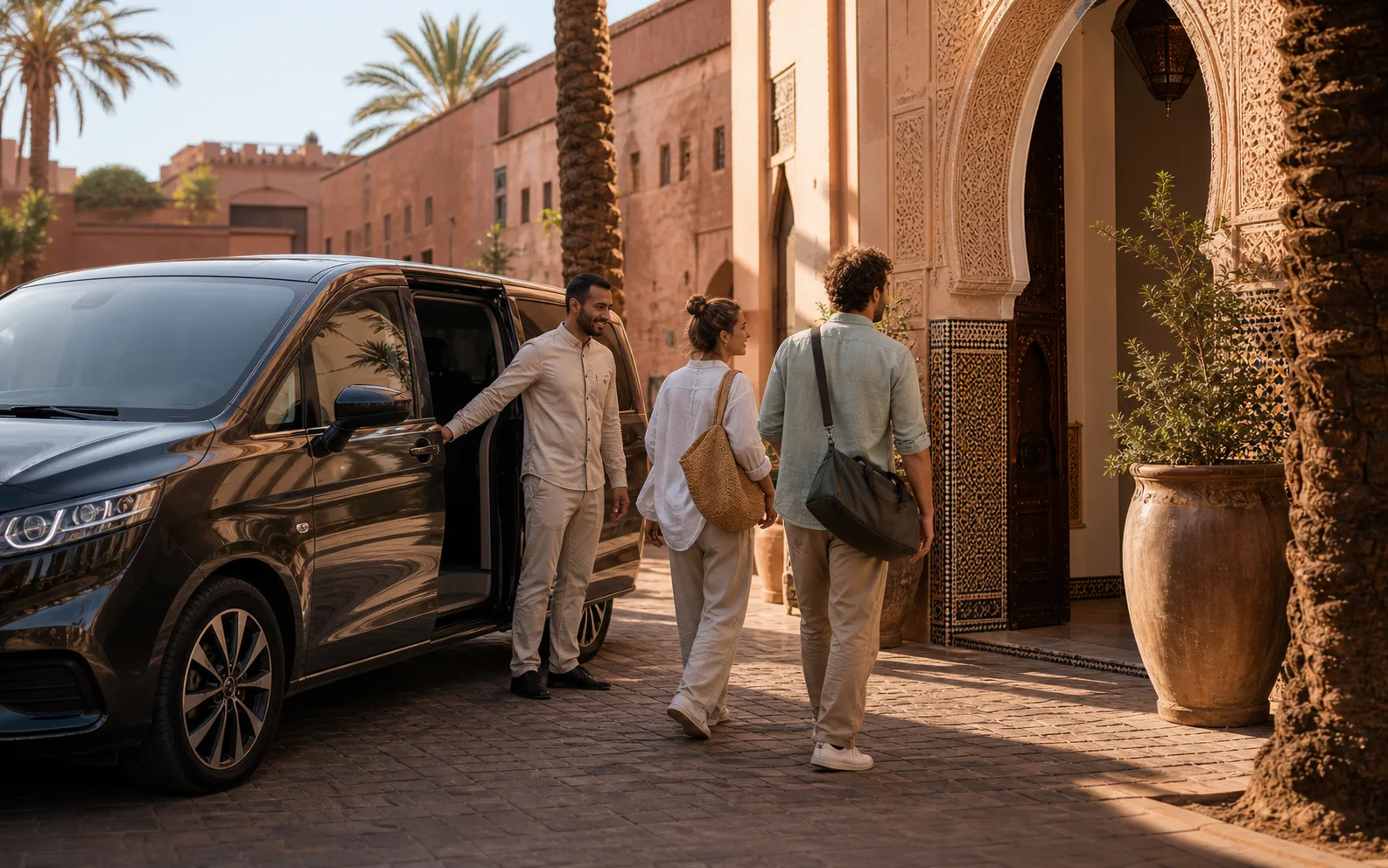
For anything off the rail corridor, a private driver-guide is the comfortable choice: door-to-door from your riad, all your luggage, your own schedule, and the freedom to stop at a viewpoint, a co-op or a kasbah on the way. The Atlas passes and desert pistes are demanding to self-drive, and a good driver doubles as a guide and translator.
Taxis and city transport
Within cities, small 'petit taxis' handle short hops — red in Casablanca, and required by law to run a meter, so insist on it. Larger 'grand taxis' run fixed intercity routes. For arrivals at Casablanca Mohammed V (CMN), Morocco's main hub, a pre-booked private transfer with a flight-tracked, name-board pickup spares you the arrivals-hall haggling entirely; the alternative is the airport train to Casa Voyageurs.
Frequently asked
Is it better to take the train or hire a driver in Morocco?
On the Tangier–Rabat–Casablanca–Fes–Marrakech corridor, the train is fast and cheap, and Casablanca is the natural hub to change at. For Chefchaouen, the Atlas, Ouarzazate and the Sahara — where there's no useful train — a private driver is the comfortable, flexible way to travel.
Should I rent a car in Morocco?
Self-driving is fine on the motorways but demanding in the medinas (no cars), the Atlas passes and the desert pistes. Most visitors prefer a private driver, who also navigates, translates and guides.
How do I get from the airport to my hotel or riad?
From Casablanca Mohammed V (CMN), pre-book a private transfer with a fixed price and a name-board pickup, or take the airport train to Casa Voyageurs. Marrakech and Fes medinas are partly car-free, so your driver will walk you the last few minutes to the riad door.
Planning a trip?
Let a Casablanca-based team handle the details.
Tell us your dates and style and we'll send a written itinerary and a transparent quote within 24 hours.
Request an itineraryKeep reading
Planning
Morocco Travel Costs & Budget
Morocco can be done on almost any budget. Mid-range travellers spend roughly US$80–150 per person per day; private, riad-based trips with a driver-guide typically run US$200–400+ per day depending on season and style.
Planning
Is Morocco Safe to Visit?
Yes — Morocco is one of the safest and most welcoming countries in North Africa for travellers, with a well-established tourism industry. The main day-to-day issues are petty scams and medina hustle, both easily managed.
Planning
The Best Time to Visit Morocco
Spring (March–May) and autumn (September–November) are the best all-round times to visit Morocco — warm days, cool evenings and ideal conditions for the medinas, mountains, coast and desert alike. Most visitors land at Casablanca (CMN), the country's main international gateway, where Atlantic air keeps the seasons milder than the interior.