
Morocco runs on Darija (Moroccan Arabic) in daily life and French in business and signage — plus Classical Arabic, Tamazight and some Spanish in the north. A handful of phrases opens doors that money alone cannot.
Updated June 2026 · 4 min read · Culture
Greetings and basics
Greetings matter enormously in Morocco. Opening an interaction with the right words signals respect and almost always produces a warmer response. Darija greetings are similar to Modern Standard Arabic but with a distinctly Moroccan accent — the 'q' often becomes a glottal stop, and vowels are compressed. Don't worry about perfection; the attempt is what counts.
- Salam / Salam alaykum — Hello / Peace be upon you (standard greeting)
- Wa alaykum salam — And upon you peace (response)
- Labas? / Labas, hamdullah — How are you? / Fine, praise God
- Shukran — Thank you
- La shukran — No, thank you (essential for polite refusals)
- Smah liya — Excuse me / I'm sorry
- Bslama — Goodbye
- Wakha — OK / Alright
Numbers and money
Numbers in Moroccan Arabic (Darija) follow a familiar pattern from Modern Standard Arabic. For market haggling and taxi fares, these are the most useful:
- Wahed, jouj, tlata, rba, khamsa — 1, 2, 3, 4, 5
- Stta, sba, tmanya, tsa'oud, a'shra — 6, 7, 8, 9, 10
- A'shr-in, tlat-in — 20, 30 (and so on by tens)
- Miya — 100 | Alf — 1,000
- Bshhal? — How much?
- Ghali bzzaf — Too expensive
- Khfef shwiya — A little cheaper
- Mashi mushkil — No problem
French essentials
French is the language of menus, hotels, road signs and — above all — business in Morocco, a legacy of the French Protectorate (1912–1956) that remains deeply embedded. Nowhere is it more useful than in Casablanca, the commercial capital, where French is the default language of offices, banks, the Corniche restaurants and the airport. Even basic French dramatically expands what you can communicate from the moment you land at CMN.
- Bonjour / Bonsoir — Good day / Good evening
- S'il vous plaît / Merci — Please / Thank you
- L'addition, s'il vous plaît — The bill, please
- Où est...? — Where is...?
- Je voudrais... — I would like...
- Combien ça coûte? — How much does it cost?
- C'est trop cher — It's too expensive
- Parlez-vous anglais? — Do you speak English?
Pronunciation notes and haggling
Darija compresses vowels significantly compared with Modern Standard Arabic — 'drari' (children) sounds almost like a single syllable. The letters 'gh' (غ) and 'kh' (خ) are guttural sounds not in English: 'gh' resembles a soft French 'r'; 'kh' resembles the 'ch' in 'loch'. Neither is difficult with a little practice.
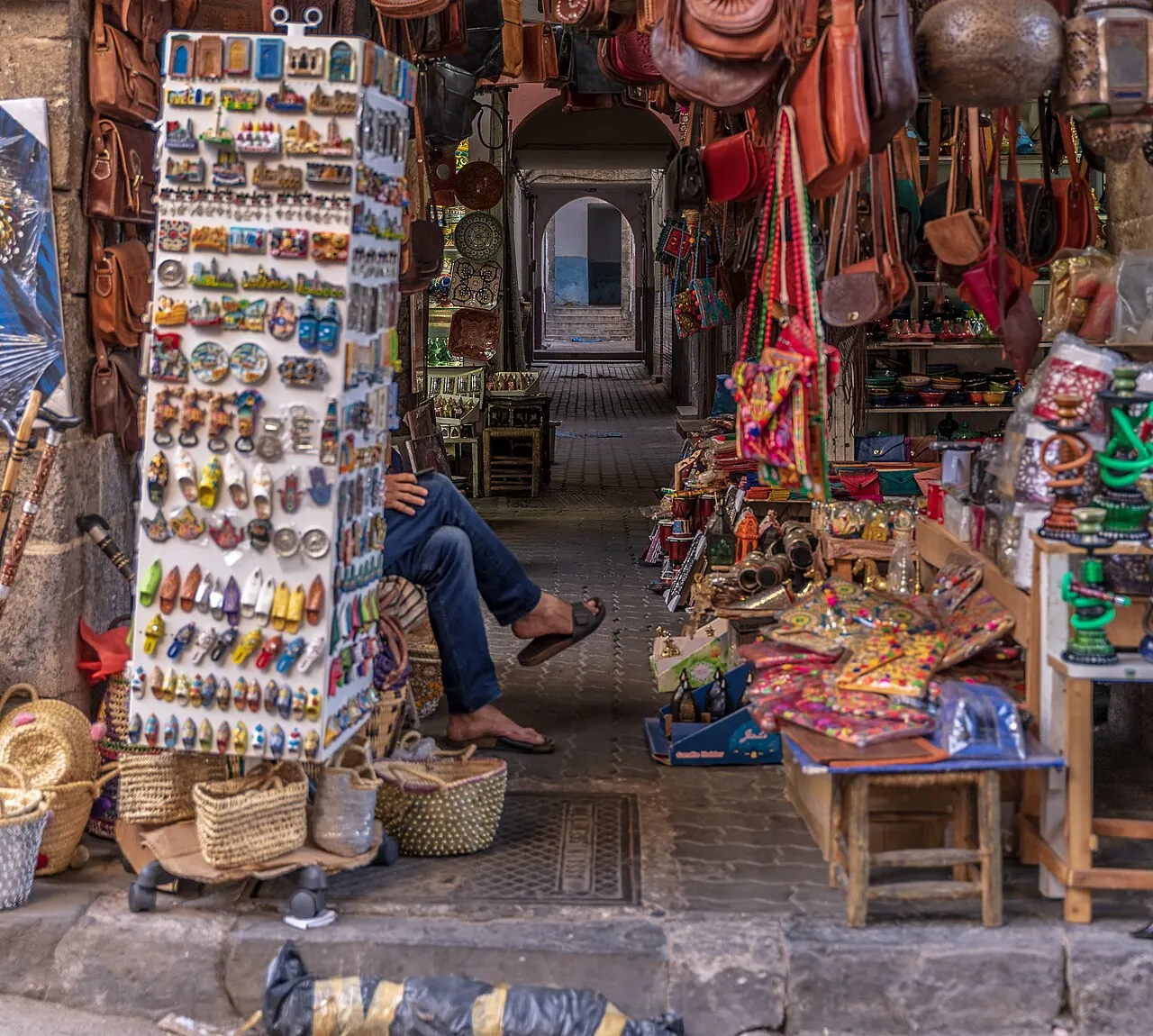
For haggling in the souks, the ritual is friendly and expected. Open in French or Darija, ask 'bshhal?' (how much?), respond to the price with a wince and 'ghali bzzaf' (too expensive), offer roughly 40–60% of the opening price, and negotiate from there. A smile and good humour throughout make the exchange enjoyable for both sides. Walking away — slowly — often produces the final best price.