Casablanca is Morocco's economic capital and biggest city — a sprawling, working metropolis rather than a compact medina town. That has one practical consequence for visitors: the sights you want are spread out, so it pays to think about how you'll move between them. The good news is that getting around is straightforward once you know the options. The headline is the tramway, backed up by taxis for the gaps, a useful train network with two central stations, and a direct airport line. Here's how each one works and when to use it.
The short answer
Use the Casa Tram where the lines go — it's the cheapest, easiest way to cross the city. Fill the gaps with a red petit taxi for short hops, agreeing the meter or fare first. Take the train for longer journeys and day trips, from Casa-Port in the centre or Casa-Voyageurs for long-distance and high-speed services. And use the airport train to and from Mohammed V (CMN). Walk the downtown and the Corniche; ride between districts.
Getting around at a glance
| Option | What it's for | Good to know |
|---|---|---|
| Tramway (Casa Tram) | Crossing the city between districts | Cheap, modern; rechargeable card |
| Petit taxi (red) | Short hops within the city | Agree meter or fare first |
| Grand taxi (white) | Shared, fixed routes & nearby towns | Set rate per seat; fills up |
| Train | Long distance & day trips | Casa-Port & Casa-Voyageurs |
| Airport train | Mohammed V (CMN) ↔ the city | ~30–45 min; runs to a timetable |
The tramway — Casa Tram
The Casablanca tramway is the city's transport success story and the option to reach for first. It's a modern, cheap and easy network of several lines that link many of the districts you'll actually want — a smooth, predictable ride that sails past the traffic the roads get bogged down in. For visitors it removes a lot of the friction of moving around a big city.
In practice you buy a rechargeable card, top it up and tap as you ride; fares are low. Trams run frequently through the day, so you rarely wait long. The one thing to check is whether the line map covers your particular route — the network has grown over time, but it can't reach everywhere — and to fill any gaps with a short taxi at either end.
Taxis — petits and grands
The petit taxi is the everyday city taxi — small, red, and used for short hops across town where the tram doesn't go. Flag one down and, ideally, ask for the meter or agree the fare before you set off, especially at night or for longer runs. They're plentiful and inexpensive, and they're the natural partner to the tram for door-to-door journeys.
The grand taxi is a different beast: larger, usually white, and run as a shared service along fixed routes, often between districts or out to nearby towns. They typically fill up with several passengers and charge a set rate per seat. For getting around the city itself you'll usually want a petit taxi; grands taxis come into their own for set inter-town runs.
The train & the two stations
Casablanca sits at the heart of Morocco's rail network, and the train is the easy way to leave the city or take a day trip. There are two main stations, and which you use depends on your journey:
Casa-Port is the central, downtown station beside the port — handy if you're based in the city centre and convenient for the area around the Hassan II Mosque. Casa-Voyageurs is the main long-distance hub, including Al Boraq high-speed services and the line out to the airport. For a quick hop to Rabat you might use Casa-Port; for a long-distance or high-speed train, or the airport, you'll generally be at Casa-Voyageurs.
The airport train
A dedicated airport train links Mohammed V airport (CMN) to the city, and it's the simplest, most predictable way in or out — no haggling, no traffic surprises. It connects through to the rail network, with a typical journey of roughly 30 to 45 minutes depending on your destination station and the timetable. Because trains run to a schedule rather than constantly, it's worth checking departure times so you're not left waiting. Taxis are also available at the airport — as always, agree the fare before you set off.
Ride apps — a word of caution
Grey-market ride apps do operate in Casablanca, but their official status has been uncertain over the years, so it's sensible to treat them with a degree of caution rather than assume they work exactly as they would at home. The reassuring news is that you rarely need them: the tram plus official red petit taxis covers most visitors' needs comfortably. If you do use an app, apply the usual common sense — confirm the car and the route, and keep a backup in mind.
Walking — downtown & the Corniche
Not everything needs a ride. The Art-Deco downtown core — the cinemas, civic buildings and apartment blocks around United Nations Square — is genuinely pleasant on foot, and the seafront Corniche at Ain Diab is made for a stroll, with the sea on one side and cafés and restaurants on the other. Explore each of these on foot and use the tram or a taxi to get between them. Casablanca is too large and spread out to walk end to end, so the trick is to walk the good bits and ride the distances.
A few practical tips
- Lead with the tram. Where a line serves your route, it's the cheapest and least stressful option — pick up a rechargeable card early.
- Settle taxi fares up front. Ask for the meter in a petit taxi, or agree the price before you get in, especially after dark.
- Match the station to the trip. Casa-Port for central and short hops; Casa-Voyageurs for long-distance, high-speed and the airport.
- Plan your hops. It's a big city — group sights by area so you're not criss-crossing it, and allow time for traffic by road.
- Keep small change handy for taxis and tram top-ups, and a little patience for a working metropolis at rush hour.
For more on basing yourself well and timing your visit, see our Casablanca neighbourhood guide and our month-by-month guide to the best time to visit. Or browse our private tours and Morocco travel guides.
Frequently asked
What is the easiest way to get around Casablanca?
For most visitors it's a mix. The Casablanca tramway (Casa Tram) is the standout — a modern, cheap and easy network that links many of the districts you'll want to reach, so it's well worth using where the lines go. For everything off the tram, the red petit taxi is the everyday workhorse for short hops across the city. Casablanca is large and spread out, so it helps to think in terms of hops between districts rather than walking the whole way.
How does the Casablanca tram work?
Casa Tram runs modern trams on several lines that connect key parts of the city, and it's one of the simplest, most reliable ways to move around. You typically buy and top up a rechargeable card, then tap as you ride — fares are low. Trams run frequently through the day and are a comfortable, predictable option compared with battling traffic by road. Check the current line map for your route, as the network has been extended over time.
What's the difference between petits taxis and grands taxis?
Petits taxis are the small red taxis used for short trips within the city — flag one down, and ideally agree on using the meter or settle the fare before you set off, especially at night or for longer runs. Grands taxis are the larger, usually white, shared taxis that run fixed routes, often between districts or out to nearby towns; they tend to fill up with several passengers and charge a set rate per seat. For getting around the city itself, a petit taxi is usually what you want.
Which train station should I use — Casa-Port or Casa-Voyageurs?
It depends on your journey. Casa-Port is the central, downtown station — handy if you're staying in the city centre and convenient for the area around the Hassan II Mosque and the port. Casa-Voyageurs is the main long-distance hub, including Al Boraq high-speed services and the line out to the airport. If you're heading off on a long-distance train or to Mohammed V airport, you'll generally be using Casa-Voyageurs.
How do I get from Mohammed V airport into Casablanca?
There's a dedicated airport train linking Mohammed V airport (CMN) to the city, which is the simplest and most predictable option — it connects through to the rail network, with a typical journey of roughly 30 to 45 minutes depending on your destination station and the timetable. Trains run to a schedule rather than constantly, so it's worth checking departure times. Taxis are also available from the airport; agree the fare in advance.
Are ride-hailing apps available in Casablanca?
Grey-market ride apps do operate in Casablanca, but their status has been uncertain and they aren't always officially sanctioned, so treat them with some caution. Many visitors find the tram plus official red petit taxis perfectly adequate for getting around. If you do use an app, the usual sense applies — confirm the car and route, and have a backup plan.
Is Casablanca a walkable city?
Parts of it are. The Art-Deco downtown core and the seafront Corniche at Ain Diab are pleasant on foot, and you can happily explore each on its own. But Casablanca is a big, spread-out metropolis, so getting between districts — say from the centre to the Corniche or the Hassan II Mosque — usually means a tram ride or a short taxi hop rather than a long walk.
Door to door, sorted
Skip the logistics — we'll handle the moving around so you can enjoy the city.
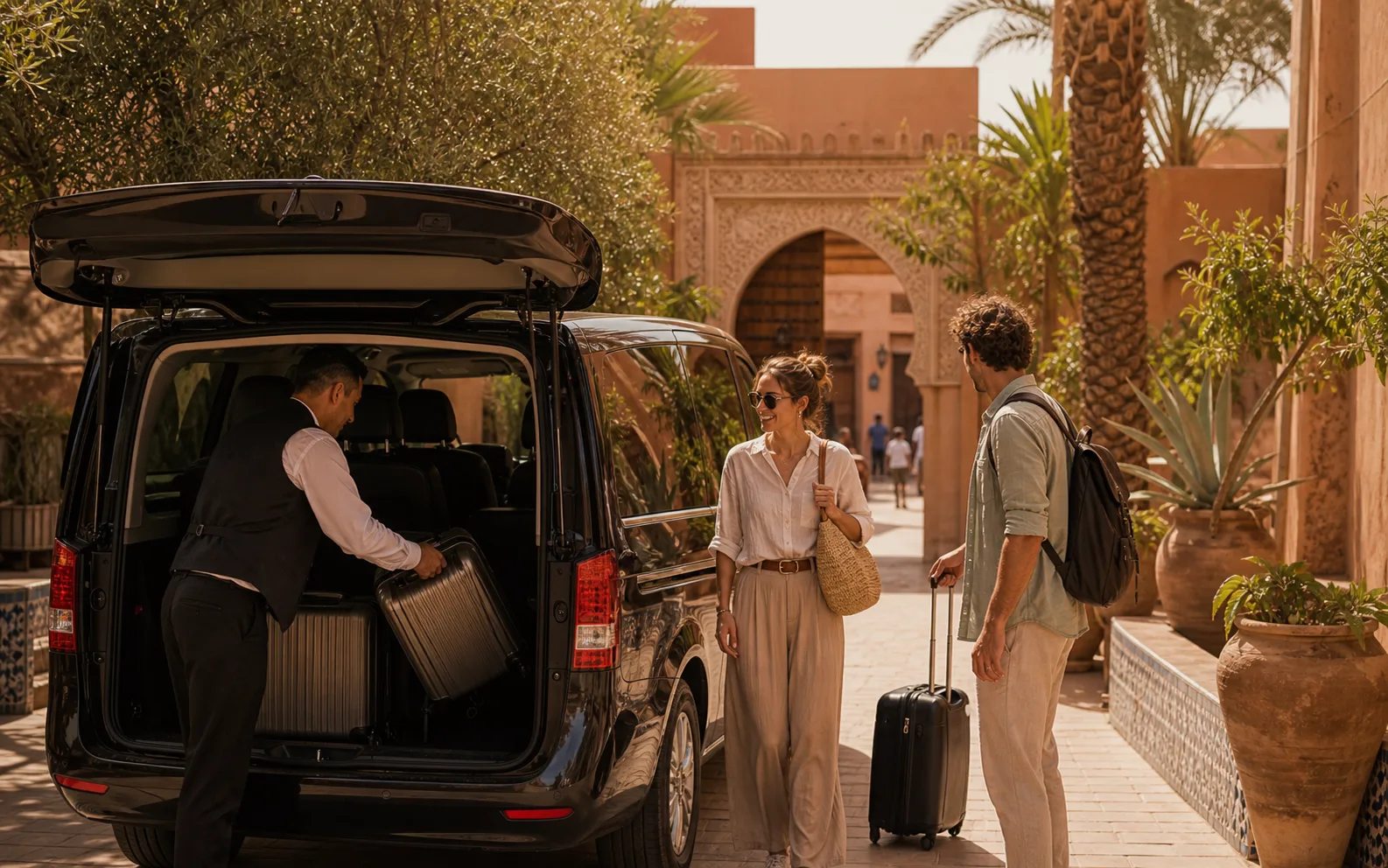
Every guest gets a pre-trip brief and a private driver-guide where it helps — airport pickups, the Hassan II Mosque, the Corniche and the Art-Deco core, all without working out a single taxi fare yourself.
Request an itinerary