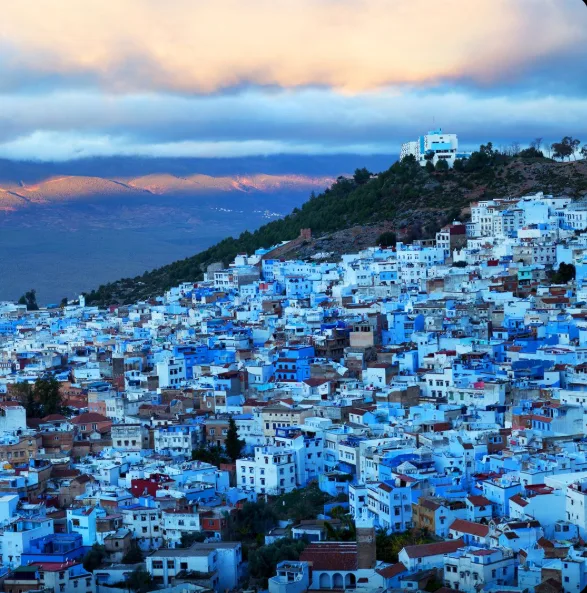
Most travellers land first at Casablanca, the country's main gateway, and Chefchaouen sits at the far end of the northern road — a natural reward on a loop up through Fès and Tangier. It perches at 600 metres in the Rif Mountains, four hours from Fès and an hour from Tetouan, and is the most photographed town in the country — also one of the most misunderstood. Visitors who arrive expecting an Instagram stage set find something more interesting: a working Moroccan mountain town with a distinct culture, a cooler climate, exceptional goat cheese, and streets that are genuinely as blue as you hoped.
Why is Chefchaouen painted blue?
The blue-and-white palette of the medina has at least three competing origin stories, all of which are probably partly true. The most historically documented explanation is Sephardic: when Jewish refugees expelled from Spain in 1492 settled in Chefchaouen, they introduced the tradition of painting thresholds and public walls in tekhelet — a blue associated in Jewish tradition with heaven and divine protection. Blue repels mosquitoes, too, which may have encouraged the broader adoption of the colour.
The practice was adopted by the Muslim population over succeeding generations and today is maintained as a point of civic identity. The municipality actively enforces a consistent palette — homeowners who repaint in unsanctioned colours are asked to correct it. Walking the medina, you notice that the blue is not uniform: some walls are cobalt, some periwinkle, some almost violet, depending on the pigment used and how many seasons of mountain weather they have absorbed. The variation is part of what makes it beautiful.
What is there to do in Chefchaouen beyond photography?
The medina is compact — walkable in forty minutes — but rewards slow exploration. Start at Plaza Uta el-Hammam, the central square, where the fifteenth-century Kasbah and its hexagonal minaret anchor the northern end. The Kasbah museum inside documents the town's Andalusian heritage with ceramics, weapons and textiles worth thirty minutes of attention.
From the square, walk east toward Ras el-Maa, the mountain spring where women traditionally wash wool in the cold rushing water. It is a working part of the town, not a tourist attraction, and the ten-minute walk takes you through increasingly local streets where the tour groups thin out. The waterfall itself is modest but the setting — blue-washed walls against the forested hillside — is excellent.
The Spanish mosque on the hill above the medina (a twenty-minute uphill walk from Plaza Uta el-Hammam) offers the best panoramic view of the blue rooftops against the Rif Mountains. Non-Muslims cannot enter, but the terrace outside is open and sunrise from here — the town still quiet, the light raking across the rooftops — is among the most memorable moments Morocco offers.
The morning market near the grand mosque sells Rif Mountain produce: fresh goat cheese (jben) sold in rush baskets, dried figs, wild thyme and oregano, hand-spun wool, and cannabis resin (openly sold in the northern Rif, legally ambiguous for foreigners — use your judgement).
Day trip or overnight: which is better?
A day trip from Fès is logistically feasible — four hours each way, three to four hours in the town — but leaves you in Chefchaouen at its most crowded, between 11am and 4pm. The blue streets are genuinely beautiful at this hour, but you are photographing them alongside significant numbers of other people doing the same.
One night changes everything. By 6pm the day-trip coaches have left. The medina reverts to its own pace: locals setting up chairs in the square, the call to prayer bouncing off the blue walls, the mountain air noticeably cooler than the city you came from. Dawn — particularly in spring and autumn — produces soft, warm light before the tour groups arrive. Two nights is our standing recommendation for anyone who wants to photograph seriously or simply exhale.
How do you route there from Casablanca?
From Casablanca (CMN): there is no quick hop. The sensible plan is to take the fast train up to Fès or Tangier first — roughly three and a half to four hours — and continue by road from there. Treat Chefchaouen as the high point of a northern loop rather than a same-day dash from the gateway.
From Fès: four hours by private car via the N13; five to six hours by CTM bus (two to three departures daily from the Fès bus station). This is the most natural pairing — Fès and Chefchaouen complement each other well as a northern Morocco circuit.
From Tangier: two to three hours by private car; Tangier Med port is an efficient entry point for travellers crossing from Spain. The Tangier–Chefchaouen–Fès route is a classic northern Morocco itinerary.
From Marrakech: six to eight hours by private car, making Chefchaouen a natural stop in a broader circuit (Marrakech — Fès — Chefchaouen — Tangier) rather than a standalone day trip from the south. No direct train serves the town; the nearest railhead is Meknès (three hours) or Tangier (two and a half hours).
See our destinations guide and private tours for itineraries that include Chefchaouen as part of a northern Morocco circuit.
What are the best photography spots in Chefchaouen?
- Rue Targhi — the most iconic lane in the blue quarter, with a staircase that photographs well from below. Best at 8–9am or 5–6pm.
- Plaza Uta el-Hammam at dusk — café lights reflecting on the blue walls; bring a wide-angle lens.
- The Spanish mosque terrace at sunrise — the only time you will have the panoramic view largely to yourself.
- Ras el-Maa — women washing wool against blue walls and rushing water; photograph respectfully and ask before including people close-up.
- The alleyways north of the Kasbah — less visited than the central quarter, with older, more faded blue walls that feel genuinely worn-in.
Frequently asked
Why is Chefchaouen painted blue?
There are a few competing stories. The one with the firmest historical footing credits Sephardic Jewish refugees, who settled in Chefchaouen after the 1492 expulsion from Spain, with introducing and sustaining the blue-and-white scheme — blue carried spiritual weight in Jewish tradition. A second account leans on a practical claim: that blue is thought to keep mosquitoes away. Over the generations the wider Muslim community took up the habit, and today the colour is a matter of civic pride upheld by local ordinance.
Is Chefchaouen worth visiting, or is it just a photo opportunity?
This is a real working mountain town — a living community with a busy wool and leather market, historic mosques and an Andalusian-Moroccan character all its own, distinct from Marrakech or Fès. Yes, the photography pulls people in, but there's genuine substance underneath. Stay a night or two and you get the medina once the day-trippers have gone: quieter, cooler and far more authentic.
How do you get to Chefchaouen from Marrakech or Fès?
Coming from Fès, count on roughly four hours by private car, or five to six hours aboard a CTM bus — which makes Chefchaouen an easy overnight tacked onto a Fès itinerary. From Marrakech it's a longer six to eight hours by private car, so it works best slotted into a northern Morocco loop taking in Fès and Tangier. No train runs to Chefchaouen itself; your nearest railheads are Meknès or Tangier. Travellers arriving at CMN typically reach it on that northern circuit rather than direct.
Is a day trip to Chefchaouen from Fès enough?
You can do it in a day, but it feels hurried — arriving around midday, you get three to four hours in the medina at its busiest, then head back in the late afternoon. Staying over changes everything: the blue streets at dusk and dawn, with the tour groups gone, are a different place altogether. For a relaxed visit we'd suggest two nights as a minimum.
What is the best time of year to visit Chefchaouen?
Spring (March–May) and autumn (September–November) bring the kindest daytime temperatures — 18–24°C — along with the crispest light for photography. In summer the town swells with Moroccan domestic visitors fleeing the coastal heat, and July and August get notably crowded. Winter turns cold and now and then snowy — lovely to look at, but pack warm layers.
What should you not miss in Chefchaouen?
The blue quarter of the medina around Plaza Uta el-Hammam is the obvious starting point. Past that, climb to the Spanish mosque on the hill above town for the most-photographed panorama of blue rooftops — best caught at sunrise. Over on the eastern edge of the medina, the Ras el-Maa waterfall is a local meeting spot and well worth the ten-minute walk. And the wool and goat-cheese market near the grand mosque, open in the mornings, is the real, local thing.
Northern loops from the gateway
We build Chefchaouen into itineraries that make sense.
From your Casablanca landing: Fès, Chefchaouen, Tangier — or a full northern loop. Private car, hand-picked guesthouses, early starts. Tell us what you are looking for.
Request an itinerary