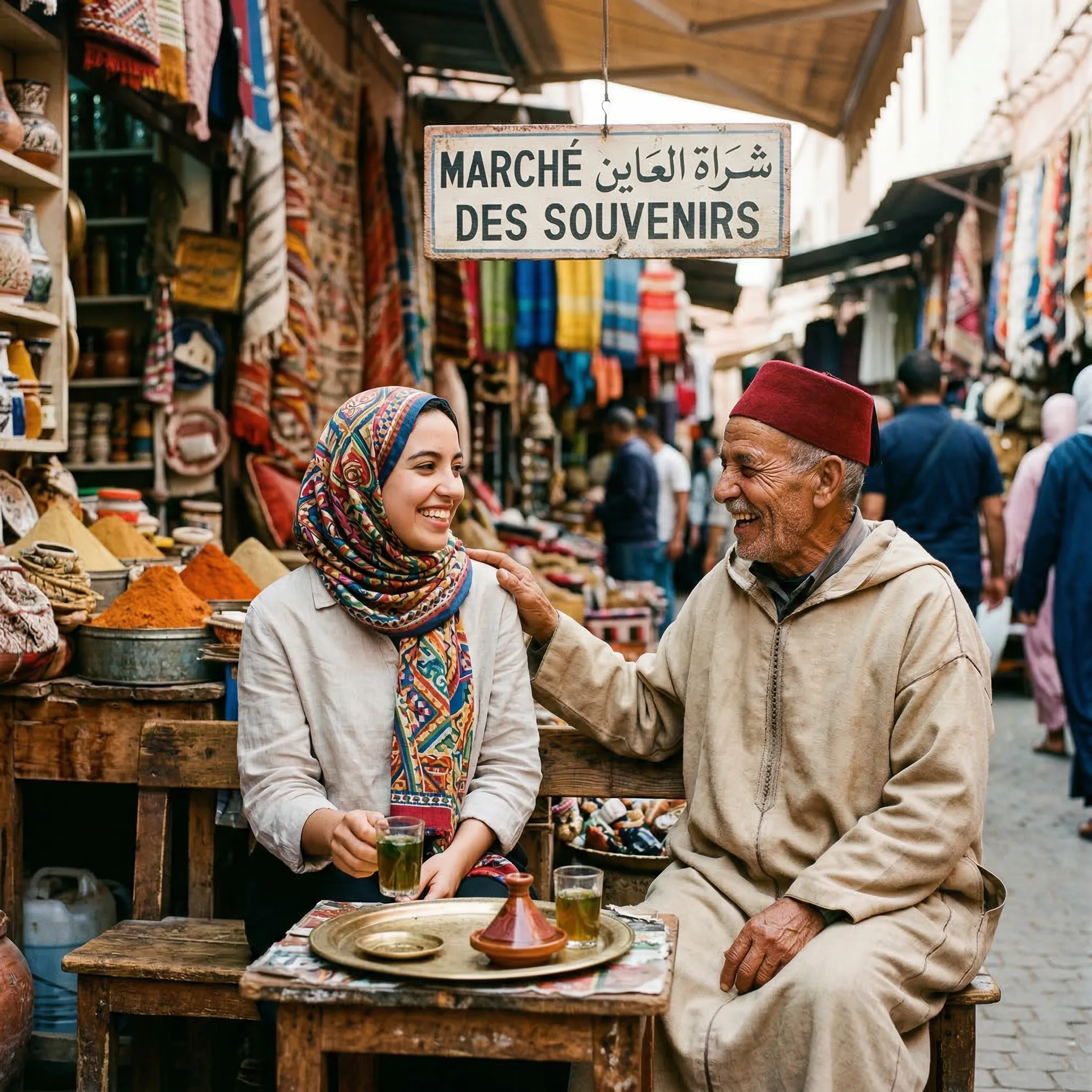
Your first real taste of Morocco rarely waits for the medina. It tends to arrive in Casablanca itself — set down on a marble-topped table in an Art-Deco salon, carried across a hotel courtyard, or poured at a terrace facing the Atlantic on the Corniche. Atay, they call it in Darija: gunpowder green tea, a fistful of spearmint, more sugar than you expect, sent in a long ribbon from the spout into a small gilt-rimmed glass and passed to you in both hands. Treat it as a drink and you miss the point. It is the opening line of Moroccan hospitality — and in a city whose whole character is built on greeting arrivals, you will be offered that line again and again.
How a Chinese leaf became Morocco's welcome
The tea itself is an import with a long memory. Gunpowder green leaf travelled in on British trading ships in the mid-1700s, when London was busy opening Atlantic routes along this very coast — the same sea that breaks below the Hassan II Mosque today. The court took to it faster than to coffee, and within a generation it had displaced the older herbal infusions and absorbed all the ceremony that hospitality already demanded. The mint was the local hand on the recipe: nana spearmint, grown in quantity in the valleys inland. Bitter leaf, cool mint, frank sweetness — the balance set early and has barely shifted in two centuries.
Watching it made, glass by glass
Nothing about the brew is rushed, and that is the whole intent. A splash of boiling water hits the loose leaf in the berrad — the slim steel pot — gets swirled and thrown away; that rinse strips the first harshness and rouses the tea. Then fresh boiling water, and a tight bunch of spearmint pressed down into the pot. The sugar comes next, and the quantity tends to startle a newcomer: four, perhaps five spoons to a pot. Back onto the flame for a short simmer, and the host begins to test — pouring a glass, tasting, tipping it back, adjusting. The serving pour drops from thirty or forty centimetres up, a deliberate fall that aerates the tea and raises the band of fine foam, the keskas, that a good host takes quiet pride in. Three glasses come off one pot, and each tastes a shade different from the last as the mint keeps working.
Why they call it 'Berber whisky'
The nickname is a knowing wink. In households where alcohol has no place, this tea does the social work a generous measure of whisky might do elsewhere — it is what you press on a guest, what loosens an hour of talk, what marks respect. Try the phrase on a Casablanca host and you will almost always be met with a grin. It has run through English travel writing since the 1960s, and a version of the joke lives in Darija as well. Read it correctly: not a jibe, but a small boast — an acknowledgement that the ritual is wholly Morocco's own.
How to be a good guest
A handful of manners carry you through. Take the first glass with both hands, or the right hand alone — never just the left. Don't gulp; the tea is scalding and the talk is the actual event. Three rounds is the figure, and turning down the first reads as cold, while a soft baraka after the third closes things gracefully. You needn't praise it — the host already knows their tea is good. And in a shop, a glass obliges you to nothing, whatever the patter suggests: it is hospitality, freely given, and you may finish it and leave with a clear conscience. Under a private roof, though, sit out all three — slipping away early cuts the welcome short.
The same ritual, a hundred local accents
The pot changes as you cross the country. Down in the Saharan south the Tuareg habit shows — three separate brews, each darker and sweeter than the one before — and it is from there that the line "one for health, one for love, one for death" entered the wider Moroccan vocabulary. Up in the blue lanes of the Rif, a little wormwood (chiba) goes in beside the mint for a clean, bitter edge. Here on the Atlantic seaboard, plenty of Casablanca families finish the pot with a few drops of orange-blossom water, a coastal grace note you will not always taste inland. The old imperial cities keep the ceremony at its most formal — the tray, the glasses, the pour, all a matter of standing. And against all that, a glass tipped into a plastic cup at a roadside stall for 5 MAD will be every bit as good.
Making it once you're home
It travels better than you would think. Two things are non-negotiable: Chinese gunpowder green tea, which any decent tea merchant stocks, and genuinely fresh spearmint. The pour from height is just a knack — rehearse it over the sink before you inflict it on guests. Go easy on the sugar if you must, but go too far and you lose the very tension between sweet and bitter that makes the drink. The right vessel is a proper narrow-spouted steel berrad, and many of our guests carry one back from a Moroccan craft quarter such as the Habous — the most genuinely useful souvenir they bring home.
Frequently asked
Why is Moroccan mint tea called 'Berber whisky'?
It's a wry bit of local humour. Morocco is largely Muslim and alcohol seldom features in traditional households, yet mint tea gets poured with all the ceremony, hospitality and abundance you might find whisky offered with in a Scottish home. The phrase goes back at least to the mid-20th century, and Moroccans use it about themselves with real affection.
What type of mint is used in Moroccan tea?
The classic is spearmint — nana in Darija — bright, cool and faintly sweet. Through summer, some households toss in a handful of wormwood (chiba) for a bitter, herbier edge. Down in the Saharan south, desert plants stand in when fresh mint runs short. The one thing you'll never meet is peppermint, which Moroccans find far too sharp.
How many glasses of tea is it polite to accept?
Three is the number by tradition — one for health, one for love, one for death, per the well-known Tuareg saying that long ago crossed into Moroccan life. Turning down the first glass comes across as rude, while seeing all three through is warm and respectful. Once you've had the third, a gentle 'baraka' (thank you, I'm satisfied) is understood perfectly.
Can you ask for tea without sugar in Morocco?
You're free to ask — 'bla sukkar, afak' (without sugar, please) — and most hosts will do their best, even if traditionalists find the request a touch puzzling. To plenty of Moroccans, mint tea without sugar is a handshake without the hand. A middle path: 'shwiya sukkar' (a little sugar) usually gets you a softer sweetness.
Is there a specific time of day for the tea ritual?
There's no set hour — tea suits any moment. It greets an arrival, seals a deal, follows a walk, or rounds off a meal. Mid-haggle in a souk, it often hints that a bargain is nearly struck. Under a roof, it's the very first thing pressed on any guest. The whole point is hospitality, not the clock.
Experience it properly
A welcome glass the day you land in Casablanca.
Every Casablanca Tours itinerary opens with a welcome glass the day you land in the gateway city. We can also set up a private tea ceremony with a master pourer — the full history and the technique behind the ritual, glass by glass.