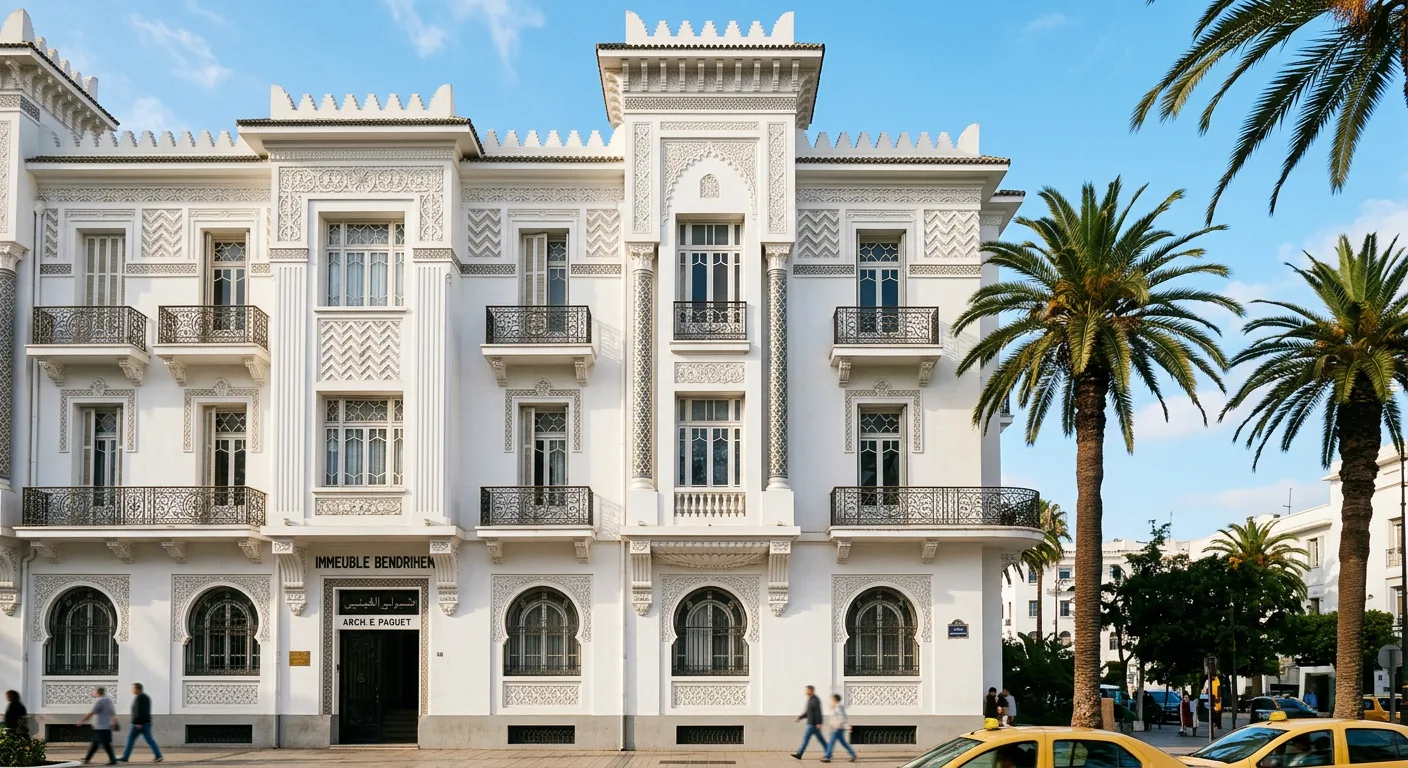
Casablanca holds one of the world's greatest concentrations of 1920s and 1930s architecture, a city-sized open-air museum of Art Deco blended with Moorish 'Mauresque' detailing. Built during the protectorate-era boom, the downtown's cinemas, hotels, apartment blocks and civic buildings remain the city's most distinctive draw. Here is what to see, and how to walk it.
The old commercial downtown around Boulevard Mohammed V is the heart of Art Deco Casablanca. Its early-20th-century boulevards are lined with apartment blocks, banks and former hotels carrying geometric balconies, curved corners and stepped cornices — best appreciated by looking up above the shopfronts.
02Civic
Place Mohammed V
The civic centrepiece of the planned colonial city, this grand square is ringed by monumental public buildings in Mauresque and Art Deco styles — the courthouse, the prefecture with its clock tower, the central post office and the former Bank of Morocco — arranged around a fountain and open plaza.
03Landmark
Cinema Rialto
Opened in 1930, the Rialto is one of Casablanca's best-loved Art Deco cinemas, a survivor of the city's golden age of picture palaces. Its facade, marquee and intimate auditorium evoke the 1930s; it still operates as a cinema and occasional concert venue near the central market.
04Landmark
Hotel Lincoln
The Hotel Lincoln on Boulevard Mohammed V is among the city's most famous Mauresque buildings, a 1916 corner block long left as a romantic ruin and an emblem of Casablanca's threatened heritage. It has been the subject of restoration efforts aimed at saving its distinctive arched and tiled facade.
05Landmark
Marche Central
The Central Market on Boulevard Mohammed V dates to the 1910s and anchors the downtown. Behind its arched colonial entrance, stalls of fish, flowers, produce and spices surround small seafood eateries — a working market that doubles as a landmark on any Art Deco walk.
06Architecture
Mauresque facades
Casablanca's signature style fuses Art Deco geometry with Moorish motifs — horseshoe arches, carved plaster, zellij tilework and wrought-iron balconies. Architects such as Marius Boyer shaped the skyline, and the resulting 'Mauresque' facades are scattered along the downtown's main avenues.
07Itinerary
Self-guided Art Deco walking route
A rewarding loop starts at Place Mohammed V, runs along Boulevard Mohammed V past the Central Market, Cinema Rialto and the Hotel Lincoln, and threads the side streets of the centre-ville. Allow a couple of hours on foot, camera in hand, and keep looking up at the upper storeys where the best detailing survives.
08Culture
Villa des Arts
Set in a restored 1934 Art Deco villa with a garden near the Arab League Park, this contemporary art museum is itself a fine example of the period's domestic architecture. It hosts rotating exhibitions of Moroccan and international artists, and admission is free.
09Architecture
Cathedrale du Sacre-Coeur
This former cathedral beside the Arab League Park, completed in the 1930s, is a striking white Art Deco landmark with soaring twin towers. No longer used for worship, it now serves as an exhibition and event space, and its luminous interior is worth a look on a downtown walk.
10District
Parc de la Ligue Arabe
The Arab League Park, laid out in the 1910s, is the green frame to much of the Art Deco district. Its palm-lined promenades link the Villa des Arts and the former cathedral and make a shaded resting point between stretches of architecture-spotting downtown.
Frequently asked
Why is Casablanca famous for Art Deco?
During the French protectorate in the 1910s to 1930s, Casablanca grew rapidly and was built largely in the fashionable architecture of the day. The result is one of the world's richest surviving concentrations of Art Deco, much of it blended with Moorish detailing into a local 'Mauresque' style.
What is Mauresque architecture?
Mauresque (Moorish-style) architecture is Casablanca's signature blend of Art Deco geometry with traditional Moroccan elements — horseshoe arches, carved plaster, zellij tiles and ironwork balconies. It defines many of the city centre's most photographed facades.
Can you do an Art Deco walking tour of Casablanca?
Yes. A self-guided walk through the centre-ville takes in Place Mohammed V, Boulevard Mohammed V, the Central Market, Cinema Rialto and the Hotel Lincoln in a couple of hours. Guided heritage walks are also available for the context behind the buildings.
Is the Hotel Lincoln open to visitors?
The Hotel Lincoln is a famous Mauresque building on Boulevard Mohammed V that fell into ruin and has been the focus of restoration efforts. It is best appreciated from the street as an architectural landmark rather than as an operating hotel.
See it with a local
Turn this into a private Casablanca trip.
We'll build a private, guided plan around the experiences you care about — with a driver, hand-picked riads and a written quote in 24 hours.