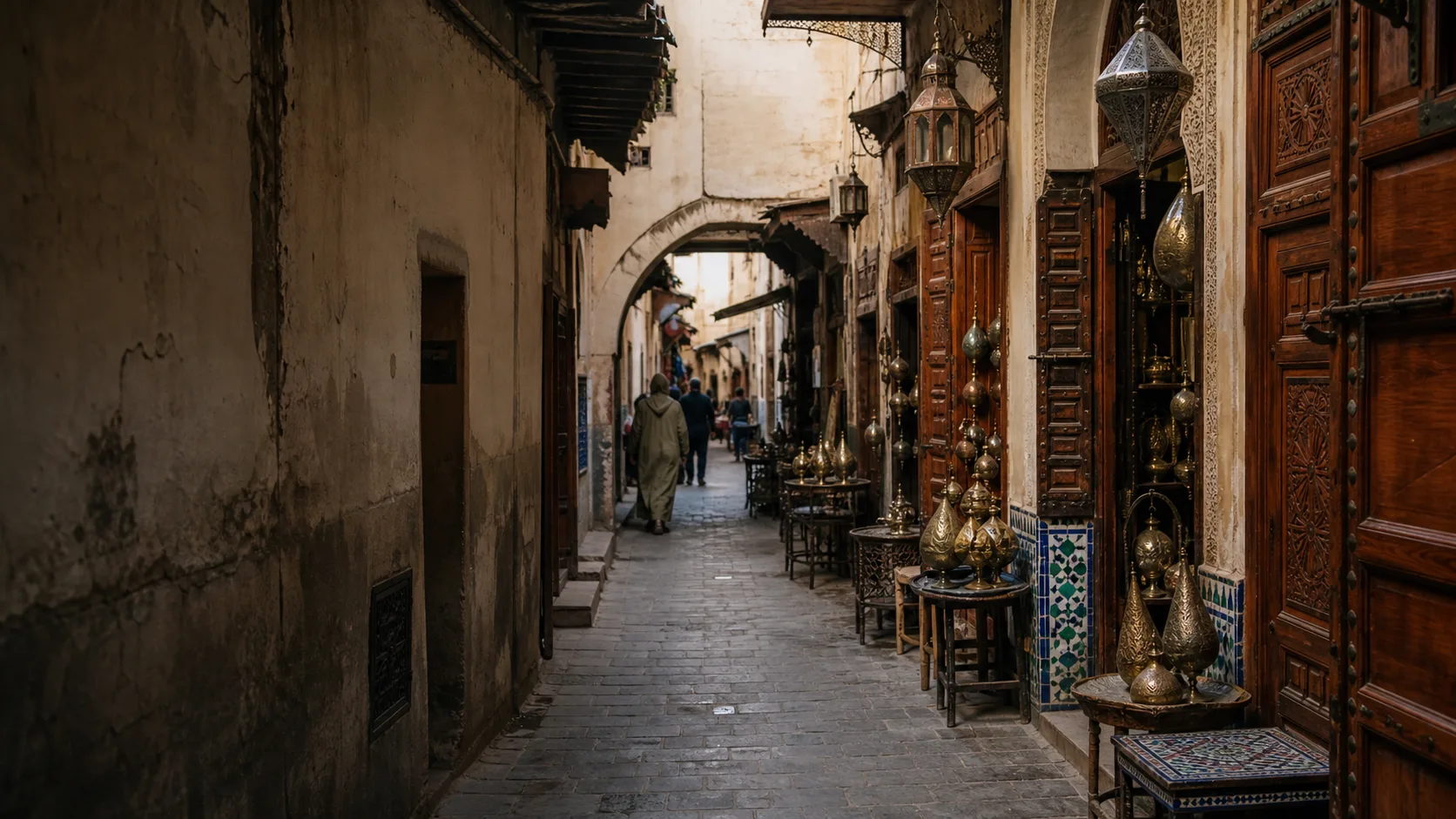
The Mahkama du Pacha is one of Casablanca's most lavish showcases of traditional Moroccan craftsmanship — a striking public building tucked into the Quartier Habous, the city's planned 'New Medina'. Completed in the early 1950s, it served both as a courthouse and as the pasha's reception palace and administrative seat, and it was conceived in a Hispano-Moorish, or Mauresque, style. Behind its long arcaded facade lie dozens of rooms — often cited as around sixty — filled with intricately carved cedar ceilings, sculpted stucco, zellij tilework, wrought iron and marble, arranged around fountained courtyards. It remains a working official building, so public access can be limited and irregular; here is what to know before you go.
The Mahkama du Pacha was built as the seat of the pasha — the local governor — and combined judicial and administrative functions with grand reception halls. In effect it worked as both a courthouse and a ceremonial palace, where official business, audiences and rulings took place. That dual role explains its scale and richness: it was meant to impress visitors and dignitaries as much as to house everyday administration.
02About
When it was built
The building was completed in the early 1950s, late in the French protectorate period, as part of the wider development of the Quartier Habous. Rather than copying a single historic monument, it gathered traditional Moroccan decorative techniques into a purpose-built civic palace, making it one of the more recent yet most elaborate examples of the craft tradition in Casablanca.
03Architecture
Hispano-Moorish style
Architecturally the Mahkama is a showcase of the Hispano-Moorish, or Mauresque, manner — horseshoe arches, arcaded galleries, tiled courtyards and richly worked surfaces drawn from Andalusian and Moroccan tradition. The style ties it to the broader Habous quarter, which was planned in the same spirit, and to a wider revival of Moroccan craft forms in 20th-century civic buildings.
04Craftsmanship
Carved cedar ceilings
Among the building's signatures are its painted and intricately carved cedar ceilings, worked in the traditional manner with geometric and floral motifs. Cedar has long been prized in Moroccan craftsmanship for fine joinery and carving, and the ceilings here are frequently singled out as a highlight for anyone who manages to see the interior.
05Craftsmanship
Stucco, zellij and ironwork
Beyond the woodwork, the rooms display sculpted stucco (carved plaster), zellij — the hand-cut mosaic tilework characteristic of Moroccan decoration — and wrought iron, alongside marble detailing. The combination of these crafts across so many rooms makes the Mahkama a kind of catalogue of traditional Moroccan ornament gathered under one roof.
06Craftsmanship
Courtyards and fountains
The interior is organised around courtyards with fountains, in the classic Moroccan pattern that brings light, air and water into the heart of a building. These tiled, fountained spaces give the Mahkama its calm, palatial feel and are central to its appeal, framing the carved and tiled rooms that open off them.
07Heritage
Its place in the Habous
The Mahkama stands within the Quartier Habous, the New Medina laid out in the early 20th century as a planned reinterpretation of a traditional Moroccan medina. The building anchors part of the quarter and shares its design language, so visiting it makes most sense as part of exploring the wider Habous of arcaded lanes, craft shops and the Moulay Youssef Mosque.
08Practical
Access can be limited
Because the Mahkama remains a working official building, public access is limited and irregular. Visiting may only be possible at certain times, by prior arrangement, or not at all when the building is in official use. There is no fixed tourist timetable to rely on, so it is best to check locally — with a guide, hotel or on the spot — before counting on going inside.
09Practical
Photography
When access is allowed, the carved ceilings, tiled courtyards and fountains are the standout subjects, and soft daylight in the courtyards tends to photograph best. As with any active official building, follow any rules or guidance given on the day about where photography is permitted, and be prepared for the exterior alone if the interior is closed.
10Itinerary
Combining with the Quartier Habous
The Mahkama pairs naturally with a wider walk through the Quartier Habous and a broader Casablanca day. Many visitors fold it into an afternoon of browsing the Habous craft arcades and seeing the central mosque, often alongside the Hassan II Mosque and the Art Deco downtown, treating the Mahkama as a bonus to enjoy if access happens to be open while you are there.
Frequently asked
What is the Mahkama du Pacha in Casablanca?
The Mahkama du Pacha is a striking public building in Casablanca's Quartier Habous (New Medina), completed in the early 1950s. It served as both a courthouse and the pasha's reception palace and administrative seat, and is celebrated as a showcase of traditional Moroccan craftsmanship in a Hispano-Moorish style, with dozens of richly decorated rooms and courtyards.
Can you visit the Mahkama du Pacha?
Access is limited and irregular because the Mahkama is still a working official building. Visits may only be possible at certain times or by prior arrangement, and entry is not always guaranteed. It is best to check locally — with a guide, your hotel or on the spot — before planning to go inside, rather than assuming fixed opening hours.
What can you see inside the Mahkama du Pacha?
When it is open, the interior is known for its many rooms — often cited as around sixty — decorated with intricately carved cedar ceilings, sculpted stucco, zellij tilework, wrought iron and marble, arranged around fountained courtyards. Together they make the building one of Casablanca's finest displays of traditional Moroccan decorative crafts.
Where is the Mahkama du Pacha and what is nearby?
It stands in the Quartier Habous, Casablanca's planned New Medina, and shares the quarter's Hispano-Moorish design. It is easily combined with a walk through the Habous craft arcades and the central Moulay Youssef Mosque, and pairs well with other city sights such as the Hassan II Mosque and the Art Deco downtown.
See it with a local
Turn this into a private Casablanca trip.
We'll build a private, guided plan around the experiences you care about — with a driver, hand-picked riads and a written quote in 24 hours.