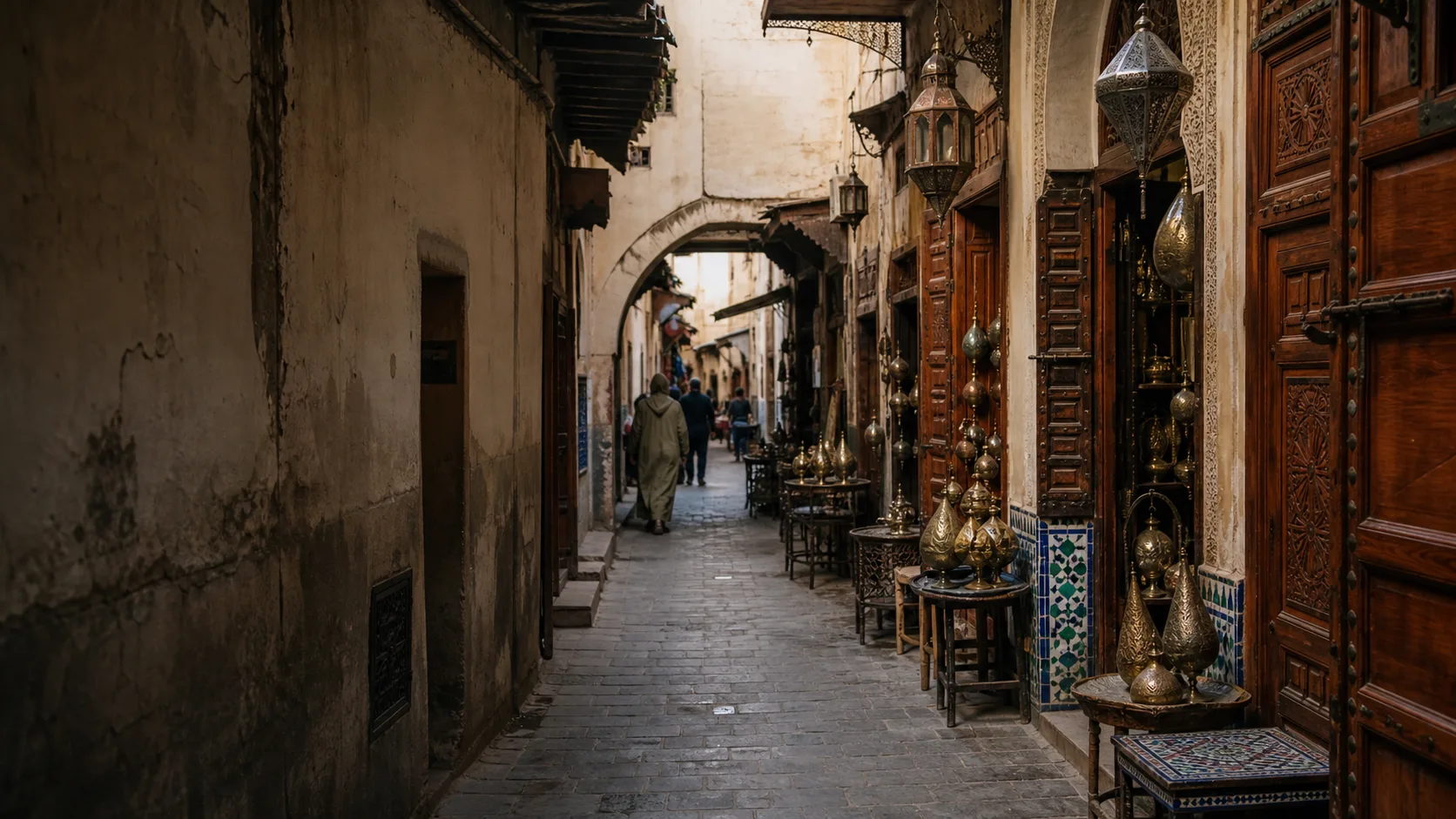
The Quartier Habous, often called the New Medina, is Casablanca's most atmospheric quarter — a 1930s reinterpretation of a traditional Moroccan medina built during the French protectorate. Its arcaded lanes, craft shops, bookstalls and Moorish-style buildings make it the city's best place to browse, buy souvenirs and sense the old-Morocco feel that the modern downtown lacks. Here is what to see and how to explore it.
Laid out in the 1910s to 1930s as a planned 'new medina', the Habous district was designed by French architects to blend traditional Moroccan urban forms with the order of European town planning. The result is a calmer, more regular take on a medina — arcaded streets, low whitewashed buildings and a mosque at its heart — distinct from the genuinely old medinas of Fes or Marrakech.
02Shopping
Arcaded shopping lanes
The covered arcades and small squares are lined with shops selling Moroccan crafts — brassware, leather, ceramics, carpets, babouche slippers, lanterns and traditional clothing. It is one of Casablanca's most pleasant places to browse and bargain, calmer and more orderly than a traditional souk.
03Landmark
Mahkama du Pacha
This imposing 1940s building was a Pasha's courthouse and reception hall, richly decorated with carved cedar ceilings, zellij tilework, wrought iron and fountains across many rooms and courtyards. It is one of the quarter's architectural highlights; opening to visitors can be irregular, so check locally before planning a visit.
04Landmark
Moulay Youssef Mosque
The handsome mosque at the heart of the Habous, with its green-tiled minaret, anchors the quarter and reflects the district's blend of Moroccan tradition and 20th-century planning. As an active mosque its interior is generally not open to non-Muslim visitors, but the exterior and surrounding square are worth seeing.
05Market
Olive and book stalls
The Habous is known for its open-air stalls of olives, dried fruit and traditional sweets, and for a cluster of Arabic and French bookshops. Browsing the produce displays and bookstalls gives the quarter a working, lived-in feel alongside the souvenir trade.
06Food
Patisserie Bennis Habous
A celebrated traditional patisserie in the quarter, long known for Moroccan sweets and pastries such as cornes de gazelle and almond-based treats. It is a popular stop for a taste of local confectionery; hours and stock vary, so go earlier in the day.
07Landmark
Royal Palace exterior
The Casablanca Royal Palace sits beside the Habous, screened by ornate gates and walls. The palace itself is not open to the public, but the decorated gateways and surrounding walls are an easy add-on while exploring the quarter on foot.
08Practical
Best time & how long
Allow roughly an hour or two to wander the arcades, shop and see the main buildings. Mornings and late afternoons are most pleasant; many shops keep traditional hours and some close around midday or on Fridays, so timing matters if you have specific stops in mind.
09Itinerary
Combining with the city
The Habous pairs naturally with a wider Casablanca day — many visitors combine it with the Hassan II Mosque, the Art Deco downtown around Place Mohammed V and the Ain Diab corniche. It is a short taxi ride from the centre and works well as an afternoon stop for crafts and atmosphere.
Frequently asked
What is the Quartier Habous in Casablanca?
The Quartier Habous, or New Medina, is a district built in the early 20th century during the French protectorate as a planned reinterpretation of a traditional Moroccan medina. It is known for its arcaded lanes, craft shops, bookstalls and Moorish-style architecture, and is one of Casablanca's most atmospheric quarters.
What can you buy in the Habous quarter?
The Habous is one of Casablanca's best places for Moroccan crafts and souvenirs — brassware, leather goods, ceramics, carpets, babouche slippers, lanterns and traditional clothing — alongside olive and sweet stalls and traditional bookshops. Bargaining is normal in the craft shops.
Can you visit the Mahkama du Pacha?
The Mahkama du Pacha is a 1940s former courthouse and reception hall in the Habous, richly decorated with carved cedar, zellij tilework and fountains. Public access can be irregular and is not always guaranteed, so it is best to check locally or with a guide before planning a visit inside.
How long should I spend in the Habous?
Most visitors spend around one to two hours wandering the arcades, shopping and seeing the main landmarks such as the Mahkama du Pacha exterior and the central mosque. It is often combined with the Hassan II Mosque and the Art Deco downtown to fill a half day in Casablanca.
See it with a local
Turn this into a private Casablanca trip.
We'll build a private, guided plan around the experiences you care about — with a driver, hand-picked riads and a written quote in 24 hours.