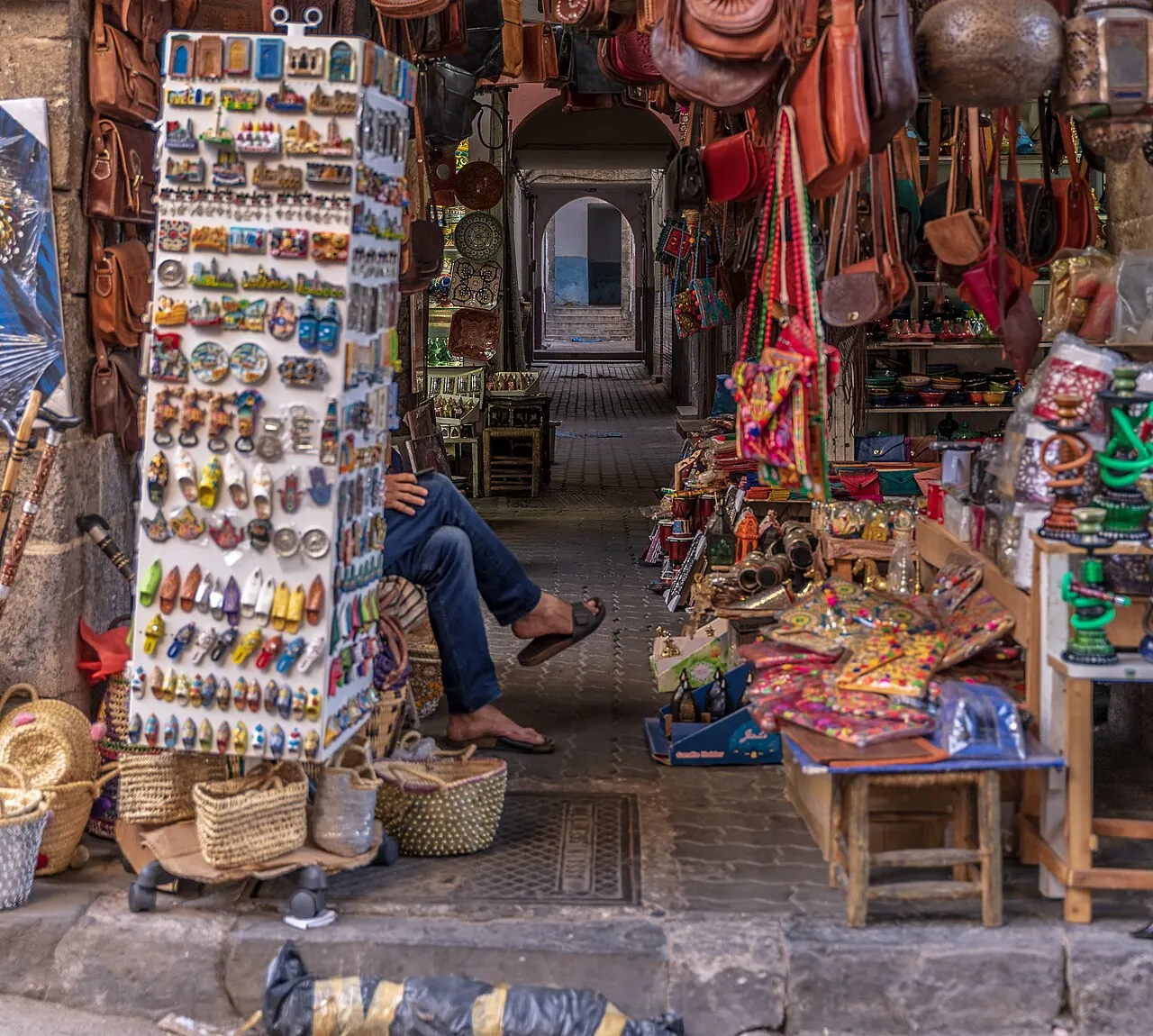

Casablanca gets most of its rain between November and March, usually in short spells rather than week-long grey stretches. When a wet day does come, the city has plenty to do under a roof: the inside of the Hassan II Mosque, small museums, a hammam, a cooking class in a local home, the big malls, films and exhibitions at the Institut français, and pastries in the Habous. This guide covers when the rain falls, where to spend a wet day, and what heavy rain does to the roads.
Indoor plans for a wet day in Casablanca
When it rains in Casablanca
Weather. Averaged over 2015 to 2024, March is the wettest month, with about 54 mm of rain on 9 days, followed by February (44 mm, 7 days), January (41 mm, 6 days), November (39 mm, 6 days) and December (35 mm, 6 days). October and April bring around 30 mm each. From June to September it barely rains at all. Winter is mild: January averages a high of 18°C and a low of 9°C. Even in March, most days are dry, so a rainy day is usually one day, not a week. Our weather-by-month guide has the full figures.
Inside the Hassan II Mosque
Heritage interior. The guided tour is the obvious wet-weather choice: it takes you through the prayer hall, the minaret hall and the ablution hall, with carved wood, zellige, marble, tadelakt and plaster all around you. From 16 September to 14 March the mosque foundation lists tours at 9:00, 10:00, 11:00, 12:00 and 15:00 from Saturday to Thursday, and 9:00, 10:00 and 15:00 on Fridays; times change in Ramadan. Cover shoulders and knees, and carry your shoes with you inside. Save the open esplanade and the ocean views for a dry spell.
The mosque museum and the city's other museums
Museums. Next to the mosque, its museum holds the craft samples made before building began. The foundation lists it as open 9:00 to 13:30 and 14:30 to 17:00 (9:00 to 15:00 in Ramadan) but does not say which days, so check. Casablanca's other museums are small and spread across the city, with different closing days. Our museums guide covers each one and when it opens.
A hammam
Wellbeing. A steam bath is a good answer to a cold, wet afternoon. Under the Hassan II Mosque esplanade there are separate women's and men's traditional hammams, each of about 3,000 m², with warm, hot and very hot rooms, plus a health bath with a heated seawater pool. They opened in August 2019, run by the mosque's foundation with the French spa group Deep Nature (le360, 7 Aug 2019). We have no recent confirmation of their hours, so check before you go. Our hammam guide explains how a visit works and the other options.
A cooking class in a local home
Food. Several Casablanca hosts teach Moroccan cooking in their own kitchens. One host listed on Traveling Spoon, Maria, teaches two dishes, usually a tagine and a chickpea and couscous salad, in her home in a gated community just outside the city, in Arabic, French or English, with a lunch or dinner session. Her market visit before the class is outdoors, so on a wet day you may prefer the class and meal on their own. Check the format and times with the host when you book.
Morocco Mall
Mall. On the Ain Diab Corniche, Morocco Mall opened in December 2011 and is often called the largest shopping centre in Africa (Wikipedia). A July 2025 profile counts over 350 shops and an IMAX cinema (Shore Africa), so a film plus lunch can fill a grey afternoon. Our Morocco Mall guide covers the rest of what is inside.
The Twin Center
Mall. The two 115 m towers in Maarif stand on a five-level shopping centre with a supermarket and boutiques. The east tower holds the Kenzi Tower Hotel, whose restaurants and bars are open to non-guests, including a restaurant on the 27th floor with views over the city (Wikipedia). We have not confirmed its current hours, so check. Our shopping guide has more on the Twin Center and the other malls.
Films and exhibitions at the Institut français
Culture. The French institute at 121 and 123 boulevard Zerktouni shows films in its Théâtre 121 and has a media library at number 121. Its spring and summer 2026 agenda lists the ticket desk as open Tuesday and Thursday 9:00 to 19:30, Wednesday and Friday 9:00 to 18:00, Saturday 9:00 to 17:00 and Sunday 10:00 to 14:00, with tickets also sold online. The programme changes every few months, and the agenda is published in French, so check what is on and the language of each screening.
Pastries and bookshops in the Habous
Cafés. The Habous, or New Medina, was laid out from 1916 under the planner Henri Prost (Wikipedia). It has bookshops of Moroccan and Arab publishing houses, small cafés and a traditional souk (Casabus). Between showers, Pâtisserie Bennis Habous is the known stop for Moroccan pastries, with coffee nearby (Secret Escapes). Shops are small, so this works best on a day of passing showers rather than a downpour.
What heavy rain does to the roads
Practical. A downpour can slow the city down. On 16 December 2025, Le Matin reported that heavy rain disrupted traffic and that residents of buildings with underground car parks were given advice after a weather alert; le360 reported the same day that main roads kept moving and underpasses stayed clear. On 1 December 2022, the first heavy rains of the season flooded some districts (Le Matin). In October 2012, more than 50 mm fell in one night and parts of the old medina and Derb Soltane flooded (Bladi). On a day with a weather alert, allow extra time between stops.
Fit it into a private day
Booking. With a private day and a driver, you move from the mosque to a museum, lunch and a hammam without waiting in the rain for a ride.
Planning a winter day in Casablanca?
Tell us your date and which indoor stops interest you, and we will plan a private day with a driver around them.
Sources
- Open-Meteo ERA5 archive: daily weather for Casablanca, 2015-2024 (averaged by month)
- Hassan II Mosque Foundation: paid guided tour
- Hassan II Mosque Foundation: museum visits
- le360: the Hassan II Mosque hammams open to the public (7 Aug 2019)
- Traveling Spoon: cooking class in a Casablanca home
- Wikipedia: Morocco Mall
- Shore Africa: Morocco Mall (Jul 2025)
- Wikipedia: Casablanca Twin Center
- Institut français de Casablanca: cultural agenda, April to July 2026
- Wikipedia: Habous (Casablanca)
- Casabus: the Habous district
- Secret Escapes: 24 hours in Casablanca (2025)
- Le Matin: Casablanca faces heavy rain and strong winds (16 Dec 2025)
- le360: heavy rain in Casablanca without major disruption (16 Dec 2025)
- Le Matin: flooding after the first rains in Casablanca (1 Dec 2022)
- Bladi: Casablanca flooded (1 Nov 2012)