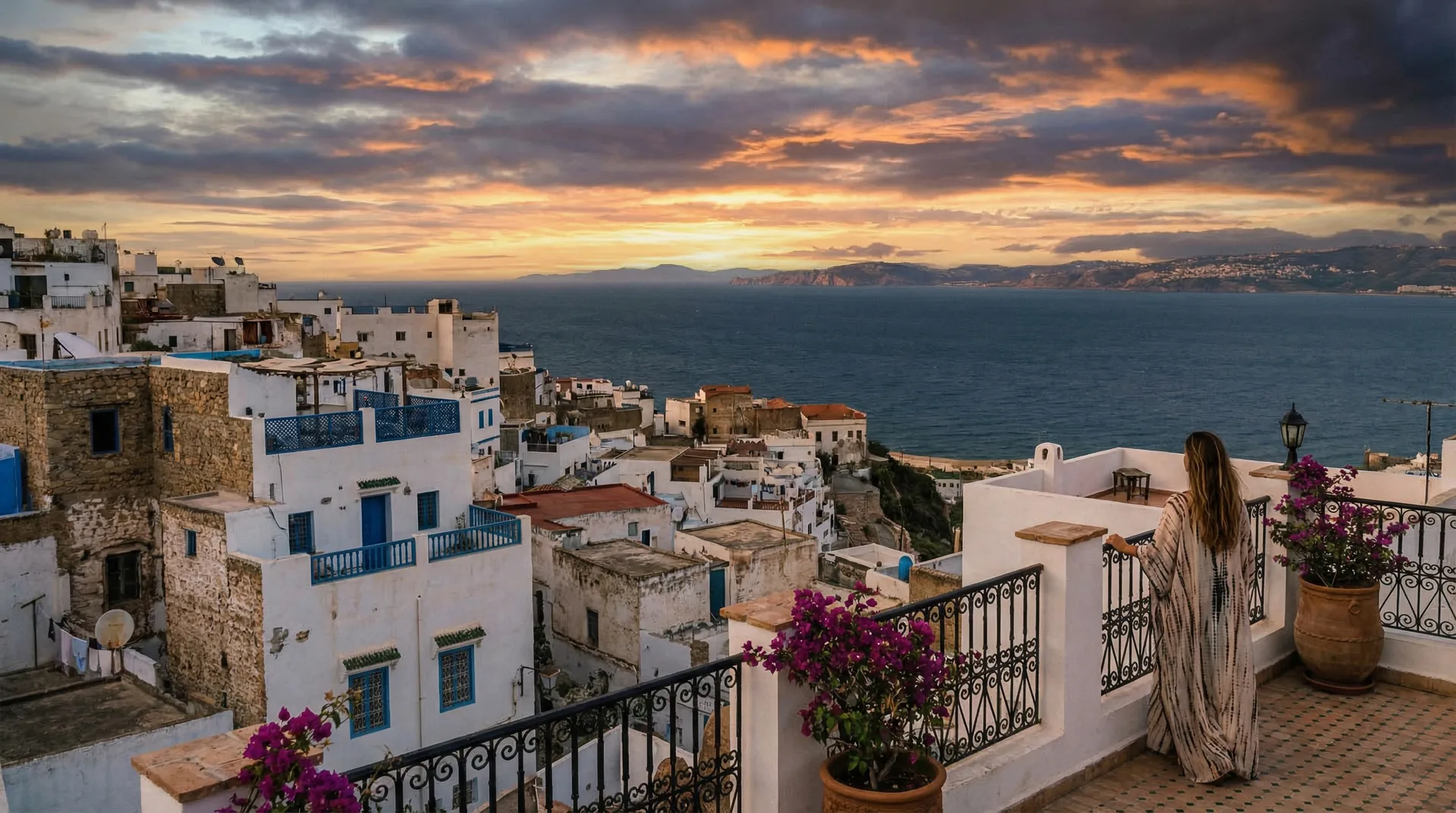
Fes vs Tangier: Ancient Medina or Gateway to Africa?
Fes is Morocco's spiritual and intellectual heartland with the world's largest car-free medina; Tangier is a restless port city where Europe meets Africa, reborn as one of the country's most dynamic urban destinations.
Northern Morocco's two most distinctive cities divide nearly everything: age, scale, character and the type of traveller they attract. Fes — founded in 789 AD — is the most complete medieval Islamic city on Earth. Its medina (Fes el-Bali) contains some 9,000 lanes, 300 mosques, the world's oldest continuously operating university (Al-Qarawiyyin, 859 AD), and craft traditions — leatherwork, zellige, copperwork — that have not changed in a thousand years. Tangier sits at the northern tip of Africa, 14 km from the Spanish coast across the Strait of Gibraltar. Once a louche international zone that inspired Paul Bowles, William S. Burroughs and Henri Matisse, today's Tangier has been dramatically transformed by investment: the Grand Socco and the Kasbah medina have been restored, the Corniche has been extended, and the high-speed Tanger-Med port makes it Morocco's busiest cargo and ferry hub. The two cities are 290 km apart and connected by a fast train — combining them is Morocco's defining northern itinerary.
Option A
Fes
The world's oldest living medieval city — tanneries, medersa and Fassi cuisine
Best for
History enthusiasts, architecture lovers, culinary explorers, slow travellers
How the two stack up across the things that actually shape a trip — read down each column, or across each row.
Category
FesTangier
Fes compared with Tangier
Character
FesMedieval, scholarly, deeply Moroccan — 9,000-lane medina; zero cars
TangierCosmopolitan, port-city energy — European influence, sea views, arts scene
Historic significance
FesFounded 789 AD; one of the world's great centres of Islamic learning
TangierInternational Zone 1923–1956; Beat Generation writers' haven; Phoenician origins
Iconic sight
FesChouara tannery; Bou Inania Medersa; Al-Qarawiyyin mosque and library
TangierKasbah Museum panorama over the Strait; Cape Spartel lighthouse; Grand Socco
Beach access
FesNone in the city; Atlas foothills and cedar forests within 2 hours
TangierMalabata beach east of centre; La Forêt Diplomatique; 90 km of Atlantic coast nearby
Getting there
FesFes–Saïss Airport (FEZ): several direct European routes; train from Casablanca 4.5 h
TangierIbn Battouta Airport (TNG): growing direct routes; ferry from Tarifa, Spain (35 min)
Train connection between cities
FesFes to Tangier: ~4 hours on ONCF; high-speed Al Boraq line cuts this to under 2 hours
TangierTangier Ville station; Al Boraq high-speed to Casablanca in 2 h 10 min
Ease of navigation
FesChallenging — most visitors hire a licensed guide for at least the first day
TangierEasier — Kasbah medina is small; Ville Nouvelle is walkable; taxis abundant
Time needed
Fes3–4 nights minimum; 5–6 to explore deeply
Tangier2–3 nights; day-trippable from Spain but deserves an overnight
Our verdict
Which should you choose?
Choose Fes for the deepest encounter with Moroccan history and craft culture — its medersa architecture, tannery panoramas and Fassi cuisine reward days of exploration and are unlike anything else on the continent. Choose Tangier if you are arriving by ferry from Spain, want sea views and a more outward-facing European-Moroccan blend, or are pressed for time. The ideal northern circuit: fly into Tangier, spend two nights, take the Al Boraq train south to Fes for four nights, add a day trip to Chefchaouen or Meknes and Volubilis, then fly home from Fes.
Fes and Tangier are approximately 290 km apart by road — around 4 hours by car via the A1 motorway. By train, the ONCF service takes about 4 hours; the Al Boraq high-speed line between Tangier and Kenitra (which connects to a faster Fes service) has reduced journey times significantly.
Is Tangier worth visiting on its own, or just as a day trip from Spain?
Tangier deserves at least one night — a day trip from Tarifa or Algeciras barely scratches the surface. The Kasbah and its museum, the Grand Socco, the American Legation (the first US public building outside America), and the atmospheric Café de Paris in the Ville Nouvelle all reward unhurried exploration. Two nights is ideal.
Which city has the better food scene, Fes or Tangier?
Fes has the stronger reputation: Fassi cuisine — bastilla (pigeon pie with almonds and cinnamon), seffa (sweet couscous), mrouzia (lamb with honey and spices) — is considered the most refined in Morocco. Tangier offers excellent fresh fish, Spanish-Moroccan tapas fusion and a more international restaurant scene, reflecting its cosmopolitan history.
Can I travel between Fes and Tangier by train?
Yes — ONCF trains run regularly between Fes and Tangier, with the journey taking approximately 4 hours. The Al Boraq high-speed service operates between Tangier and Kenitra, connecting to onward trains to Fes. Book seats in advance via the ONCF website, particularly in peak season.
Is Fes or Tangier better for solo travellers?
Both are manageable solo. Tangier's smaller Kasbah medina and more European-facing character make it slightly easier to navigate independently. In Fes, hiring a licensed guide (fassi guide) for the first day or two in the medina is strongly recommended for solo visitors — the 9,000-lane labyrinth has defeated many confident map-readers.
What is the Al Boraq train and does it stop at Fes?
Al Boraq is Morocco's first high-speed rail service, launched in 2018, connecting Tangier to Kenitra in under an hour and to Casablanca in 2 hours 10 minutes. It does not currently stop at Fes; travellers to Fes change at Kenitra or Casablanca onto conventional ONCF services for the remainder of the journey.
Ready to book?
Let a Casablanca-based team build your itinerary.
Tell us which destinations you want to combine and we'll send a written itinerary and a transparent quote within 24 hours.