Almost every Moroccan road trip begins the same way: keys collected at CMN, Casablanca's international airport, which feeds straight onto the toll network linking the country's big cities. Few places reward a driver as generously as Morocco does — the scenery resets every hour, the passes inland are spectacular, and the licence to pull over at a roadside stall on impulse is no cliché. It is also a country that asks for your full concentration, and that starts in Casablanca's traffic itself. Here is the honest counsel we give guests who ask whether they should drive off the airport forecourt the day they arrive.
Getting clear of Casablanca itself
The hardest fifteen minutes of your whole trip are usually the first ones. Casablanca is a working city of four million, and downtown — around the Art-Deco core, the port approaches and the boulevards feeding the Corniche — moves to its own rules. The roundabouts are the real test: large, multi-lane and resolved by nerve and eye contact rather than painted priority, with scooters slipping through every gap. The trick is to commit calmly, signal late, and never hesitate mid-circle. Once you pick up the autoroute signs you are through the worst: the A3 lifts you north to Rabat, the A7 runs southeast to Marrakech, and a separate toll road heads down the coast to El Jadida. Each is a different country from the streets you just left.
What are Moroccan roads actually like?
Those tolled autoroutes radiating out of Casablanca toward Rabat, Fès, Marrakech and Tangier are first-rate: smooth, well-kept, generously signposted. Step off them and the standard varies. National routes (the N-prefixed roads) through the south and east are sealed and usually sound, but tight — two lorries crossing leave barely a hand's width between mirrors. Provincial roads (R-prefix) can break up fast after a downpour. And pistes — the unpaved tracks climbing into the mountains or the pre-Saharan valleys — call for a high-clearance 4x4. A standard hire car has no business on a piste, and we never suggest it.
How do the police barrages work?
The barrage is part of Moroccan road life, not a sign something is wrong. An officer steps out with a baton; you slow and pull up. Keep your passport, your home licence (or International Driving Permit), and the rental contract in the glove box, easy to reach. Expect a radar reading on your speed and the odd breathalyser test — Morocco runs a zero-tolerance drink-driving law, with the limit set at 0.0 g/L. Stay polite, unhurried and clear-spoken. Any fine is settled in dirhams there and then; ask for a receipt (un reçu, s'il vous plaît).
Where do you leave the car at a medina?
Casablanca is unusual in that its compact Habous quarter — the "new medina" laid out in the 1920s — is largely driveable around its edges, but the historic medinas you'll visit later, in Marrakech, Fès and Meknès, are firmly car-free. You leave the car in an attended lot outside the ramparts, where a gardien charges 10–20 MAD a day, and walk in on foot. In Fès el-Bali there is no alternative: stretches of the lanes won't admit a motorbike, let alone a car. In Marrakech you'll watch scooters and donkeys share an alley no Fiat 500 could enter. Your riad will send someone to collect you at the nearest landmark; handing over luggage at the car park is routine for them.
What does hiring a car actually cost?
Reckon on roughly US$25–40 per day for a small manual in the Dacia Sandero bracket from the international desks — Avis, Hertz, Europcar — lined up in the CMN arrivals hall, the country's busiest collection point, or at Marrakech airport. Local outfits quote less, but their cover and breakdown terms are often thin, so read the fine print before you sign. Pay for the full collision damage waiver (CDW) and theft protection — they earn their keep. Petrol sits near US$1.20 a litre (diesel a touch less), and main routes are well served by filling stations.
Why most of our guests hand over the keys
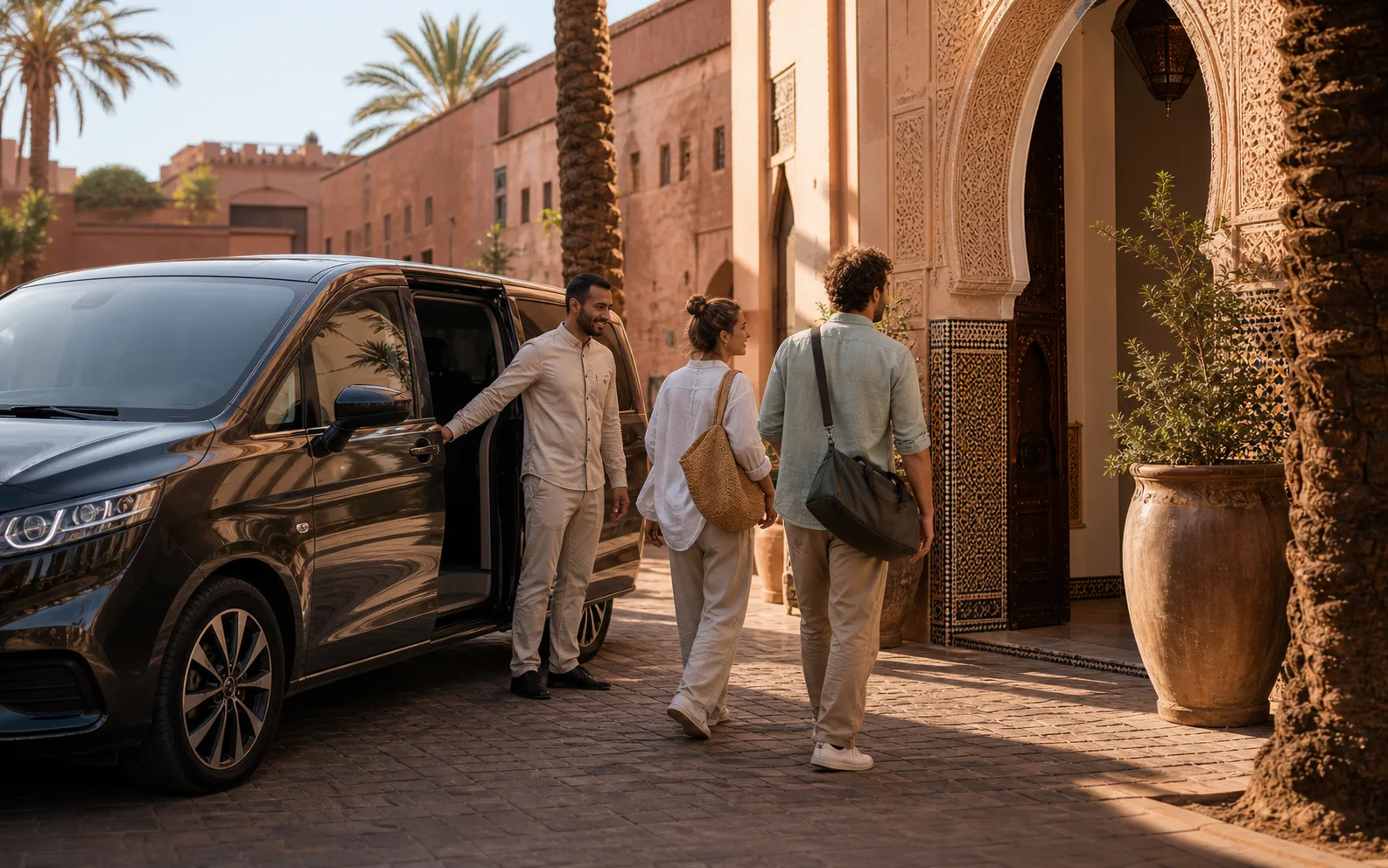
We have skin in the game — arranging chauffeured driver-guides is our trade. But the stories guests tell after self-driving first, then switching, line up neatly: the passes rattled them more than expected, parking at every stop bled hours from the day, the barrage exchange felt awkward without the language, and the holiday went on watching the road rather than the country. A chauffeur lifts every one of those weights. Over seven to ten days the gap in cost is slim — a driver-guide runs about US$150–220 per day all-in, which for a party of four is under US$60 a head per day. In return you get a local authority, a fixer, an interpreter, and someone who already knows which lay-by on the Tizi n'Tichka is worth stopping the car for. See our guide service for details.
Ground rules if you do drive yourself
- Treat Casa's roundabouts with respect: commit decisively, watch for scooters, and don't freeze mid-lane.
- Save offline maps (Maps.me or Google Maps offline) before you pull away from the hotel — the signal vanishes once you reach the mountains and the desert.
- Carry paper copies of the rental contract, the insurance, and your passport photo page in the car.
- Top up whenever the gauge drops below half — stations thin out badly east of Ouarzazate and on the Erfoud–Merzouga stretch.
- Keep to sealed roads unless you have a 4x4 and someone local expecting you at the far end.
- At a barrage: engine off, window down, hands in view on the wheel. Slow, and unhurried.
Frequently asked
How hard is it for a foreign visitor to drive out of Casablanca?
The motorways are the easy part — wide, modern and clearly marked the moment you leave CMN. The challenge is Casablanca itself: dense downtown traffic, multi-lane roundabouts where right-of-way is negotiated rather than signposted, and scooters threading between lanes. Visitors who cope well tend to be confident urban drivers who keep their speed down and avoid the roads after sunset.
What paperwork lets me collect a hire car at CMN airport?
Your home-country driving licence covers most nationalities — an International Driving Permit is not legally required. Bring your passport, a credit card in your own name, and be at least 21 (some agencies set 23 for larger vehicles). Keep the signed rental agreement and the insurance certificate in the glove box for the whole trip.
How often will police stop tourists on Moroccan roads?
Regularly, once you leave the city for the A3 or A7. An officer waves you down with a baton at a roadside barrage; ease off, lower the window, and have your passport and rental contract within reach. A short look and you are usually sent on. Speak slowly, stay relaxed and courteous — it reads well and the check ends quickly.
What are the speed limits across Morocco?
Town and city streets: 40–60 km/h. Open national roads: 100 km/h. The tolled autoroutes radiating from Casablanca: 120 km/h. Fixed cameras are everywhere and officers carry radar at checkpoints. On-the-spot fines are settled in cash dirhams, and the signage follows standard European conventions.
Should I hand the driving to a private chauffeur instead?
For a first Moroccan trip, almost always yes. A private driver-guide erases the friction points — Casa's roundabouts, medina parking, the language at a barrage, dead signal in the hills — and brings local knowledge no app carries. Spread across a week or ten days, the extra cost is small against the rest of the budget.
Is it sensible to drive between cities after dark?
We advise strongly against it. Unlit scooters, livestock straying onto the carriageway, badly marked speed bumps and tiredness make night the single biggest hazard for visitors. Time your day to reach your hotel before dusk, above all on the coastal road south and the mountain runs inland.
Met at arrivals, the driving handled
Put a driver-guide in the front seat.
We find you in the CMN arrivals hall and carry it from there. Our chauffeurs are licensed, English-speaking, and know every road in this guide by heart — Casa's roundabouts included. Want more depth? We'll pair the driver with a dedicated local guide at each stop.