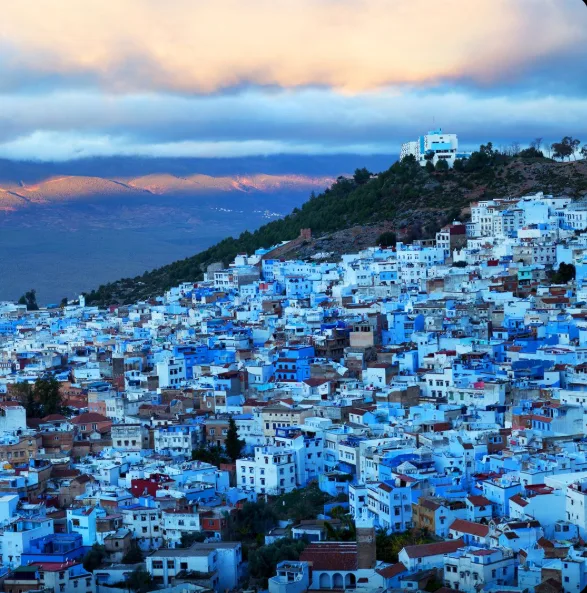
No question reaches us more often, and it usually comes from guests an hour out from Casablanca — the country's main port of entry and, for most, their first handshake with Morocco. The short answer: yes, Morocco is safe for the great majority of visitors, and has been for decades. The longer answer — the one worth your time — turns on where you go, how you move, and which risks you are genuinely weighing. Here is what we tell guests plainly, from the CMN arrivals hall onward, with the marketing gloss left off.
Casablanca is a real city — read it like one
Set your expectations correctly at the start. Casablanca is not a postcard medina; it is a four-million-strong commercial capital with a working port, a downtown of 1930s Mauresque and Art-Deco office blocks, and the ordinary edges of any big city. Treat it as you would Marseille or Naples: pickpocketing is the realistic risk, concentrated in the crowded downtown around the central market and the busier tram stops, not violence. Keep a phone in a front pocket, leave the heavy jewellery at the hotel, and stay alert where crowds press. The Corniche seafront is lively and pleasant by day and into the evening; after midnight, as on any urban waterfront, take a registered taxi rather than walking the quieter stretches alone. The port district is for business, not strolling. None of this is cause for nerves — it is simply the difference between a working metropolis and the calm of the tourist routes that follow.
What do the official advisories actually say?
As of 2026, the UK Foreign, Commonwealth & Development Office (FCDO) and the US State Department both place Morocco at exercise normal precautions for the main tourist regions — the same line they draw for France, Spain and Portugal. The bar rises to exercise increased caution near the Algerian border and across certain Saharan frontier zones, all of which sit well off the usual route anyway. The places most visitors actually go — Casablanca, Marrakech, Fès, Chefchaouen, the Drâa Valley, Merzouga, Essaouira — all fall in the lowest advisory tier.
The tourist police (police touristique) are uniformed and visible across the major cities, and CCTV coverage through Marrakech's Djemaa el-Fna and the main souks grew sharply after 2019. This is a government whose books depend on tourism, and it spends to protect it.
What about women travelling on their own?
Plainly: solo travel for women in Morocco works, and plenty of women do it. It does call for a different register of alertness than, say, Scandinavia. Verbal attention — comments on your appearance, persistent invitations into shops — is more common than in Northern Europe. It stays words, almost always; physical crime against women travelling alone is genuinely rare, in Casablanca's downtown as elsewhere.
What actually moves the needle: cover bare shoulders in the medinas (a light linen layer costs nothing); walk like you know where you are, even on day one; pick a riad or hotel whose staff know your name and your plans; take a licensed guide for your first medina rather than going in cold; and keep your host's WhatsApp saved so a message is one tap away if something feels off. With those basics in place, the overwhelming majority of solo women we have hosted leave with nothing but good to report.
Which scams are worth knowing about?
Morocco's scams cost money and dignity, not safety. The recurring ones:
- The volunteer guide: someone offers to walk you somewhere for nothing, then names a price on arrival. Wave off all unsolicited offers; your riad can book a licensed guide.
- The phantom closure: a stranger insists a mosque, museum or square is shut and steers you elsewhere — often the family shop. Check any closure with your hotel first.
- The tea trap: a shopkeeper invites you up for mint tea, then leans hard on you to buy once you are seated. Tea is a real gesture of welcome, but inside a shop it usually carries an expectation. Accept only if you genuinely mean to browse; leave cleanly if not.
- The off-the-meter taxi: unlicensed drivers work the CMN arrivals hall and Casa-Voyageurs station. Use the official metered rank, the airport train into the city, or a transfer booked ahead through your hotel or operator.
None of it involves force. It works because travellers hate to seem rude. A calm, firm 'no thank you', in any language, settles every one of them.
And the countryside and the mountains?
Step away from Casablanca and the crime risk drops further still. The High Atlas, the Drâa Valley, the anti-Atlas and the pre-Saharan villages are arguably the safest ground in the country — rural Berber communities hold hospitality to guests as near-sacred, and petty theft is far rarer than in a crowded medina. Here the hazards are environmental: flash floods funnelling through narrow valleys between October and March, and altitude sickness above 3,000 metres. For any multi-day trek, engage a licensed mountain guide through the Bureau des Guides in Imlil or Ouarzazate.
The 2023 earthquake, centred near Al Haouz, hit High Atlas villages hard. By 2026 the main trekking routes — the Toubkal circuit among them — have been restored and are fully open, though some remote settlements are still rebuilding. Confirm the specific trail with your guide operator before you set out.
What about your health?
Have the routine jabs — tetanus, hepatitis A — current before you travel. Raise hepatitis B and typhoid with your GP if you plan long rural stays or adventure travel. Tap water beyond the top-tier hotels is not dependably safe; stick to sealed bottled water and skip ice in casual cafés and street stalls.
Food in sit-down restaurants is generally very safe, and street food is fine when it is clearly hot and freshly cooked. A few travellers get an unsettled stomach in the first days purely from unfamiliar spice and oil — not infection. Pack oral rehydration sachets and an antihistamine, and ask your GP for a broad-spectrum antibiotic to carry just in case. Travel insurance with medical evacuation cover is non-negotiable: the international-standard private hospitals are clustered in Casablanca and Marrakech.
The honest verdict
Morocco is a layered, characterful country that rewards anyone who arrives with curiosity and ordinary street sense — the same sense you would carry through any large city. The risks are real but proportionate, on a par with most big-city destinations and lower than many. We have run private tours here for years, and the great majority of our guests finish the trip already plotting the next one. If you want a journey built to maximise ease and minimise friction — from the airport transfer to vetted hotels to support on call — that is exactly what we do.
For further reading, see our Morocco travel guides and destination overviews.
Frequently asked
Is Morocco safe for women travelling solo in 2026?
Yes, with your wits about you. Huge numbers of women tour Morocco alone every year without trouble. Casablanca, Marrakech, Fès, Chefchaouen and the whole Atlantic seaboard are well-worn and broadly safe. Verbal attention in the medinas happens and is worth bracing for, but physical crime against visitors is uncommon. Covering shoulders and knees, moving with intent, and a firm 'la shukran' (no thank you) shrugs off most of it. A reputable riad with round-the-clock staff and guided excursions removes most of the rest.
Which tourist scams are most common in Morocco?
The familiar set: a 'helpful' stranger who walks you to your riad and then asks for money; a shopkeeper who leads you to a rooftop view then presses you to buy; a landmark declared 'closed' that opens the moment a guide fee changes hands. None of it is violent — it trades on social pressure. The defence is plain: know your route in advance, mention a local contact who is expecting you, and never trail after anyone who approaches you first in a medina.
How safe is rural Morocco and the Atlas?
Very. The High Atlas, the Drâa Valley and the pre-Saharan villages are among the calmest corners of the country, and the hospitality is legendary. For trekking, take a licensed local guide — less for crime than for route-finding and reading the weather. Check FCDO or State Department advice before any border-region travel (Saharan zones near the Algerian frontier deserve extra care), but the main tourist circuit is wide open.
What health precautions are worth taking for Morocco?
Keep routine jabs current (tetanus, hepatitis A); raise hepatitis B and typhoid with your GP if you plan long stretches in the countryside. Tap water isn't dependably safe beyond the big hotels — drink sealed bottled water and skip ice in casual cafés. Food in proper restaurants is generally fine, and street food is low-risk when it's hot and freshly cooked. Pack a small kit: oral rehydration salts, an antihistamine and a broad-spectrum antibiotic your GP prescribes.
Has anything about Morocco's safety changed for 2026?
Morocco stays among the steadiest, most visitor-friendly countries in North Africa and the wider Arab world. The state pours money into tourist police, medina CCTV and registered-guide systems. The 2023 earthquake struck the High Atlas; most affected areas have been rebuilt or have tourism running again — confirm specific access with operators. Standard FCDO and US State Department guidance keeps Morocco at 'exercise normal precautions', level with many popular European destinations.
Do I need travel insurance for Morocco?
Always. Choose a policy with medical evacuation cover, since the top private hospitals sit in Casablanca and Marrakech. Helicopter evacuation from the Atlas or Sahara exists but is steep without insurance. A mid-range plan at US$40–80 for a fortnight will usually cover you well. Declare any pre-existing conditions.
Met at arrivals, looked after throughout
We've got your back from the CMN arrivals hall onward.
Every Casablanca Tours trip includes a meet-and-greet at the airport, 24/7 WhatsApp support, vetted licensed guides, pre-screened accommodation and pre-arranged transfers — so you can focus on the experience, not the logistics.
Request an itinerary