The short answer: Morocco is easy to get around. The Al Boraq high-speed train links Tangier, Rabat and Casablanca; regular ONCF trains reach Fes, Meknes and Marrakech; comfortable CTM and Supratours buses cover the places the railway doesn't; and a private driver makes the most sense for the south, the Atlas and the desert, where there is no railway south of Marrakech. For most trips you'll mix the train between cities with a driver for the desert run. The detail below is practical and first-hand — but for exact times and fares, always check the official sources, because those move.
A note on times and prices
We've deliberately not printed fixed journey times, frequencies or fares. Timetables and prices change with the season and the year, and an out-of-date number is worse than none. For trains, the authoritative source is ONCF (Morocco's national rail operator); for the coaches, check CTM and Supratours directly. Book popular routes and holiday travel ahead. Everything below is about how to choose, not a schedule to plan to the minute.
The train: usually your best bet city-to-city
Morocco's railway is run by ONCF, and it's good. At the top of the network is Al Boraq, Africa's first high-speed line, which runs Tangier–Kenitra–Rabat–Casablanca. Between those northern cities it is fast, modern and comfortable, and it goes station to station in the centre of town — which usually beats both flying and driving once you count the time at each end. For the classic traveller's triangle, the conventional ONCF lines then carry you onward to Fes and Meknes in the interior and down to Marrakech. If your trip is mostly Tangier, Rabat, Casablanca, Fes, Meknes and Marrakech, the train can do almost all of the heavy lifting.
A few practical notes from experience: there are different comfort classes, seats can be reserved on the faster services, and the busiest departures — Friday evenings, Sunday returns, public holidays — fill up, so it pays to book ahead on those. Stations in the big cities are central and walkable to many hotels. Our structured getting-around-Morocco guide lays the same options out as a quick reference — this journal piece is its conversational companion.
The bus: where the train doesn't go (and it's good)
The railway doesn't reach everywhere, and that's where Morocco's intercity coaches come in. The two names to know are CTM and Supratours (Supratours is run by ONCF and is often timed to connect with trains). Both are comfortable, reliable and air-conditioned, with proper ticketed seats — a different world from informal local minibuses. They reach the places travellers most want that the train misses: Chefchaouen (the blue city), Essaouira on the coast, Agadir, and the towns of the south. For those journeys the bus is genuinely the right tool, not a compromise. As with the train, reserve popular routes ahead, and check current timetables and fares on the operators' own sites.
Grands taxis and petits taxis
Morocco has two kinds of taxi and it helps to know the difference. Petits taxis are the small city cabs for getting around within a town — they should run on the meter, so ask for it to be switched on, or agree the fare before you set off. Grands taxis are older, larger shared cars (often the classic Mercedes) that run fixed routes between nearby towns, usually leaving when full; you can pay for the whole car if you don't want to wait or share. They're handy for shorter hops the train and bus don't cover well. With grands taxis especially, agree the price first — confirm whether it's per seat or for the whole car — so there are no surprises.
When a private driver is worth it
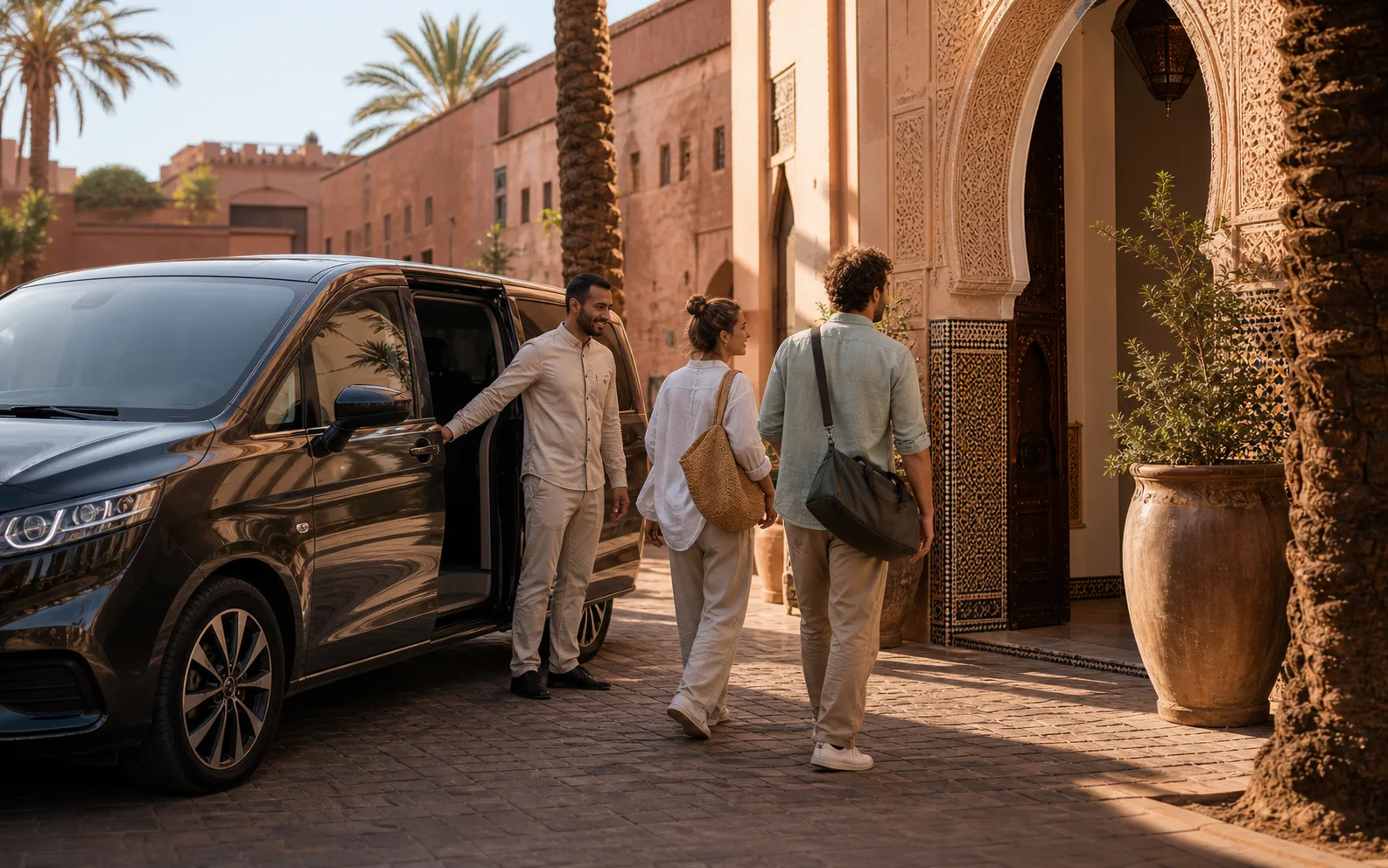
For a lot of Morocco's best travel, a private driver and car is the answer — and the clearest reason is simple: there is no railway south of Marrakech. The moment you head for the High Atlas, the south, Aït Ben Haddou, the Dadès and Todra gorges or the Sahara, the train stops being an option and the bus, while it runs, can't stop where you want. A private driver lets you stop freely for the viewpoints, cover several places in a day, travel on your own clock, and have someone who knows the mountain roads at the wheel. It's also the calmest way to do multi-stop days and door-to-door city transfers with luggage. Many visitors do exactly this: train between the cities, a private driver for the south and the desert.
That's the part we handle. If you want a comfortable, fixed-price run between cities or out to the sights, our Casablanca–Marrakech private transfer is a good example of the door-to-door approach, and our Rabat day trip from Casablanca shows how a driver turns a chain of stops into one easy day. If you'd rather self-drive, read our honest take on driving in Morocco first.
Do you ever need a domestic flight?
Usually no. For the classic circuit — the imperial cities, the coast, Marrakech and a desert trip — the train, bus and a driver cover everything, and you'd spend more time getting to and from airports than you'd save. The exception is the far south: somewhere like Dakhla, well over a thousand kilometres down the Atlantic coast, is far enough that a domestic flight genuinely makes sense rather than a very long drive. For most itineraries, though, you can plan a great trip without flying internally at all.
Getting from Casablanca airport (CMN) into the city — and onward
Most visitors arrive at Mohammed V International Airport (CMN), Morocco's main gateway, and getting into Casablanca is easy. There's a train station right under the terminal, with services into the city centre (Casa-Voyageurs and Casa-Port), and from the network you can connect onward — including picking up Al Boraq toward Rabat and Tangier. If you're carrying luggage, arriving late, or just want the simplest door-to-door option, a taxi or a pre-booked private transfer is the easy choice. We cover this in detail in our guide to getting from Casablanca airport to the city and Marrakech, and if you're only passing through, the Casablanca layover guide shows what you can fit in between flights.
Rabat, the capital, is on the same northern spine: Al Boraq stops there, so it's a quick, comfortable train hop from Casablanca, and it has its own airport (Rabat–Salé) too. For getting around within Casablanca once you've landed — the tramway, petits taxis and local trains — see our guide to getting around Casablanca.
"How would I do X to Y?" — a few worked examples
- Casablanca → Marrakech: take the train — direct ONCF services run the route and it's a relaxed ride. A private driver is the alternative if you want to stop on the way; there's a fuller Casablanca-to-Marrakech guide if you want the detail.
- Casablanca → Fes (or Meknes): the train again — conventional ONCF lines link Casablanca and Rabat to Fes and Meknes, so the imperial cities chain together neatly by rail.
- Tangier → Rabat → Casablanca: this is Al Boraq's home turf — the high-speed line connects all three, and it's the fastest, most comfortable way to move along the northern coast.
- Marrakech → the Sahara: by road only — there's no railway south of Marrakech, so you go by private driver or organised tour over the High Atlas to Merzouga or Zagora, usually as an overnight or multi-day trip.
- Anywhere → Chefchaouen or Essaouira: take the bus — CTM or Supratours, since the train doesn't reach either.
We're a Casablanca-based team, so we can put the whole thing together — airport pickup at CMN, the train legs sorted, and a private driver for the south and the desert. Browse our private tours and transfers or just get in touch. If you're still shaping the route, our 7-day Morocco itinerary shows how the trains and a driver fit together over a real trip.
Frequently asked
Does Morocco have high-speed trains?
Yes. Morocco runs Al Boraq, Africa's first high-speed rail line, linking Tangier, Kenitra, Rabat and Casablanca. It is genuinely fast and comfortable, and for travel between those northern cities it is usually the best option. Beyond that corridor, conventional ONCF trains reach Fes, Meknes and Marrakech. For current timetables, classes and fares, check the official ONCF site — those details change, so we don't quote fixed times or prices here.
How do you get from Casablanca to Marrakech?
The simplest way is the train: regular ONCF services connect Casablanca and Marrakech directly, and it's a relaxed, scenic ride. A private driver is the alternative if you want door-to-door comfort or plan to stop along the way. Buses (CTM and Supratours) also run the route. We've written a dedicated guide to the Casablanca–Marrakech journey; for exact departure times and fares, always confirm on the ONCF or bus operator's official site.
Is it better to take the train or the bus in Morocco?
Where the train goes — the Tangier–Rabat–Casablanca corridor on Al Boraq, and Casablanca/Rabat to Fes, Meknes and Marrakech on conventional ONCF lines — the train is usually the better choice: comfortable, central station to central station, and easy. The bus comes into its own for the many places the railway doesn't reach, such as Chefchaouen, Essaouira, and most of the south. CTM and Supratours are the reliable intercity operators. On busy routes and around holidays, book ahead either way.
Do you need a car or a private driver in Morocco?
Not for the train-and-bus circuit between the main cities — public transport handles that well. A private driver earns its keep when you head into the Atlas Mountains, the south and the desert, where there's no railway south of Marrakech, where sights like Aït Ben Haddou are spread out, and where you want to stop freely or cover several places in a day. Many visitors mix the two: train between cities, a private driver for the south and the desert run.
How do you get to the Sahara desert?
There's no railway south of Marrakech, so the desert is reached by road. Most people travel from Marrakech (or sometimes Fes) by private driver or an organised tour over the High Atlas to the dunes at Merzouga (Erg Chebbi) or Zagora/M'Hamid (Erg Chigaga) — typically an overnight or multi-day trip rather than a day run, given the distance. A driver who knows the route makes a real difference. Confirm current journey times locally, as road conditions and stops vary.
How do you get from Casablanca airport (CMN) into the city?
Mohammed V Airport (CMN) has a train station beneath the terminal with direct services into Casablanca (Casa-Voyageurs and Casa-Port), and from the network you can connect onward, including Al Boraq toward Rabat and Tangier. Taxis and pre-booked private transfers are the other options and are easiest with luggage or late arrivals. Check the ONCF site for the current airport-train timetable before you rely on a specific departure.
Want it all handled door to door?
Train between the cities, a private driver for the desert.
Tell us your route and dates and we'll join it up — airport pickup at CMN, the rail legs planned around real timetables, and a comfortable private driver for the Atlas, the south and the Sahara, where the trains don't run.
Plan my route