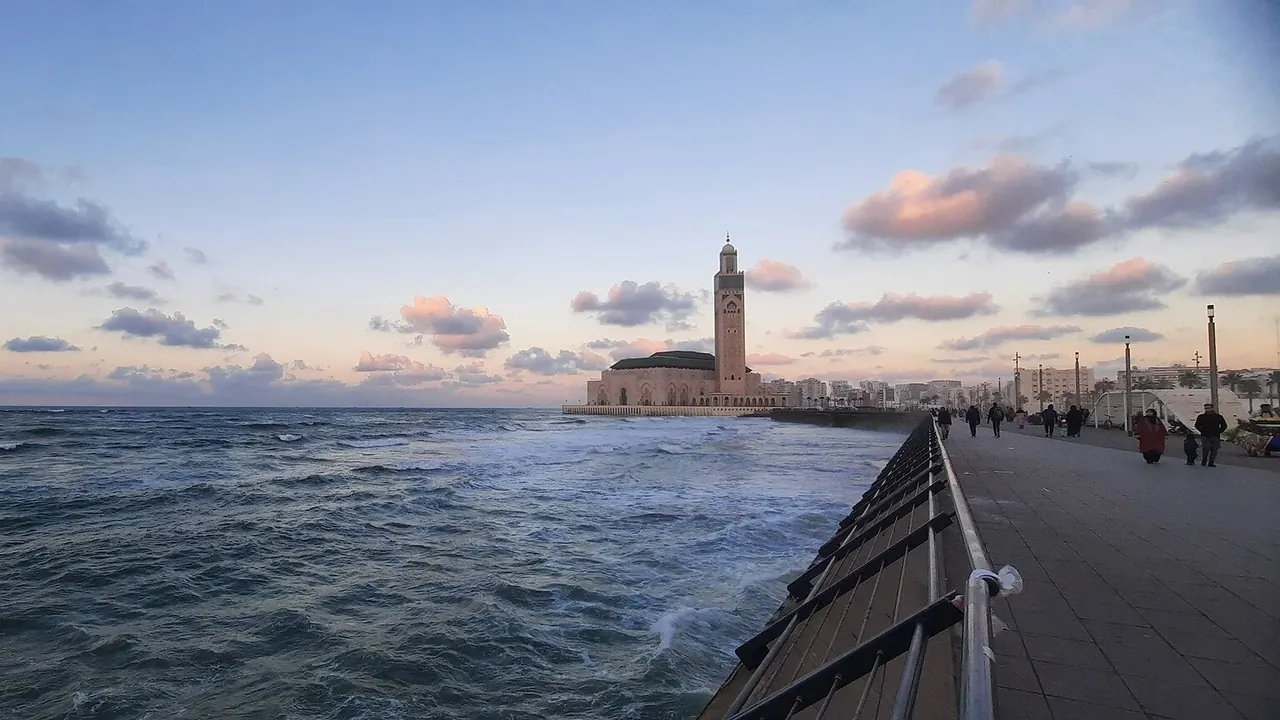

Casablanca is a city of big sea light, white Art Deco facades and one very large mosque on the water. This page covers where to stand and when: the Hassan II Mosque from the plaza and from the shore, the downtown squares and boulevards, the Habous quarter, the old medina and the Sqala, El Hank, the Corniche and Aïn Diab, the Sidi Abderrahmane islet, the business towers and the tram. It also covers the rules: asking before you photograph people, sensitive sites, Morocco's ban on bringing in drones, and prayer times and Ramadan at the mosques. For camera advice across the country, see our general Morocco photography guide.
Where to take photos in Casablanca, and the rules
Hassan II Mosque from the plaza
Hassan II Mosque. The mosque stands partly on land and partly over the Atlantic, between the harbour and the El Hank lighthouse, and its minaret rises 210 metres (Wikipedia). The outdoor esplanade can hold some 80,000 people (Barcelo), so even with a wide lens you may need to walk a few hundred metres back to fit the whole building in (Fstoppers). Fstoppers suggests the plaza at morning blue hour, and advises keeping a respectful distance from the building so the guards do not need to move you on. In the evening a laser at the top of the minaret points towards Mecca (Wikipedia), which adds a line of light to a blue-hour shot.
Hassan II Mosque from the shore
Hassan II Mosque. For the mosque against the sea, photographers recommend the shore at sunset and the marina area east of the mosque (Fstoppers). At low tide you can climb down to the rocks and find tidal pools for reflections; one photographer notes that the spot he used is normally under water and that the rocks are loose, covered in seaweed and very slippery (Daniel Korzeniewski). Check the tide table, wear shoes with grip, and do not go down on a rising tide.
Inside the mosque
Hassan II Mosque. Non-Muslims can enter only on the foundation's guided tour. The rules ban video cameras, radios and other sound devices inside, and ask visitors to stay with their group and keep quiet; the foundation's page says nothing either way about still photography, so ask your guide before you raise a camera (fmh2.ma). Shoulders, torso and knees must be covered, and you carry your shoes with you. Fridays have fewer tour slots, and there is a separate Ramadan timetable, so check fmh2.ma for the dates you travel.
Place Mohammed V
Art Deco downtown. Laid out from 1916 by Henri Prost and Joseph Marrast, the square is ringed by Moorish Revival civic buildings from the 1920s and 1930s: Joseph Marrast's courthouse (1923), Adrien Laforgue's central post office (1920), Edmond Brion's Bank Al-Maghrib (1937), Marius Boyer's Wilaya, the former city hall (1937), and Albert Laprade's former military commander's house, now the French consulate-general (Wikipedia). Casablancans call it Pigeons' Square. A 2020 renovation repaved the square and added Christian de Portzamparc's Grand Théâtre on its western side. Several of these buildings are courts or government offices; see the note on sensitive sites below.
Boulevard Mohammed V and the tram
Art Deco downtown. Boulevard Mohammed V is the spine of the Art Deco centre; look up above the shopfronts for the balconies and cornices. Line T1 of the tram, opened in December 2012, stops at the Marché Central, United Nations Square and Place Mohammed V (Wikipedia). When the tram was built, the stretch from the Marché Central to United Nations Square was planned as pedestrian and tram only (Infomediaire, 2011); check how it looks today. A tram gliding past a 1930s facade makes a good street photograph, but keep clear of the tracks while you frame it.
United Nations Square
Art Deco downtown. The square sits outside the walls of the old medina, where the old town meets the European-planned city (Wikipedia). The clock tower ordered after 1908 was demolished in 1948; the one you see now is a replica built in 1993, a short distance closer to the medina. It is one of the easiest places to photograph the tram, which serves the square on line T1.
The former Sacré-Cœur church
Art Deco downtown. Paul Tournon's white Art Deco church stands west of the Arab League Park (Wikipedia). It stopped being used for worship in 1956 and is now a cultural centre open to visitors that hosts exhibitions. The towers and the long white facade are best seen from the park side, with room to step back.
Quartier Habous and the Mahkama du Pacha
Habous. The Habous, or new medina, was built mainly in the 1920s and 1930s to plans by Albert Laprade, Auguste Cadet and Edmond Brion, to recreate a traditional medina with modern planning: arches, small squares and gardens (Barcelo). Next to it are the Royal Palace, which is not open to the public but whose main door with three horseshoe arches can be seen from outside, and the Moulay Youssef Mosque, which only Muslims may enter (Barcelo). The Mahkama du Pacha, built in 1941 and 1942 to designs by Auguste Cadet, has served as a courthouse and the pasha's residence (Wikipedia); whether you can go inside today is something to check locally.
The old medina and the Sqala
Medina. The old medina's ramparts had three main gates: Bab el-Mersa facing the harbour, Bab es-Souk to the east and Bab Marrakesh to the south (Wikipedia). The Sqala is a late 18th-century bastion on the Atlantic-facing wall, built under Sultan Sidi Mohammed ben Abdallah, with angular gun platforms and embrasures for artillery (GPSmyCity; Wikipedia). It now houses La Sqala restaurant, and from the walls the view opens over the ocean and the port. In the lanes of the medina, people live and work at close quarters: ask before you photograph anyone.
El Hank lighthouse
Coast. The 51-metre El Hank lighthouse stands at the tip of the El Hank headland, west of the port, and has worked since 1920 (Wikipedia). Its white tower is a landmark on the coast between the mosque and the Corniche. Wikipedia says it is open to visitors, with 256 steps to the upper platform; we have not confirmed current opening, so check locally before planning a climb.
The Corniche and Aïn Diab at sunset
Coast. Aïn Diab is the neighbourhood on the Corniche, Casablanca's seafront, with Lalla Meryem and Aïn Diab beaches (Wikipedia). The coast faces the open Atlantic, so late afternoon and sunset are the times for surf, silhouettes and walkers on the promenade. Tram line T2 ends at Aïn Diab beach (Wikipedia). Along the cliff below the coast road near Anfa, the Anfa Place development of homes, shops, offices and a hotel was designed to link the road to the beach (Gustafson Porter + Bowman).
Sidi Abderrahmane islet
Coast. The islet off Aïn Diab holds the shrine of Sidi Abderrahmane and is now joined to the mainland by a bridge (Wikipedia). After the houses around the shrine were demolished, the islet was reopened as a heritage site on 19 September 2024, with access limited to Tuesday to Sunday, 9:00 to 18:00 (Le Matin). The shrine is a working place of devotion; we have not confirmed whether non-Muslims may go inside, so photograph it from outside unless you are told otherwise.
Twin Center and Casablanca Finance City
Skyline. The two 28-storey, 115-metre towers of the Twin Center, by Ricardo Bofill's firm with Elie Mouyal, stand where Boulevard Zerktouni meets Boulevard Al Massira Al Khadra in Maarif (Wikipedia). Casablanca Finance City occupies the site of the old Casablanca–Anfa airport; its first tower, by Morphosis, was finished in 2019 (Wikipedia). These are the city's modern skyline shots, and they work well at dusk with the office lights on.
Photographing people
Etiquette and law. GOV.UK advises: always ask permission before taking pictures of people, especially children. Moroccan law also protects people's privacy and image. Articles 447-1 and 447-2 of the Penal Code, added by Law 103-13 on violence against women, punish capturing or recording someone's private information, and broadcasting or spreading their words or pictures without their consent, with prison and a fine (Morocco World News, 11 Dec 2018). In practice: ask, accept a no, and do not post a recognisable stranger's face online without their agreement.
Police, military and official buildings
Etiquette and law. GOV.UK says it is illegal to take photographs near sensitive political or military sites. It does not list them, and we have not found a published list. Treat police officers and checkpoints, military sites, guarded government buildings and the gates of the Royal Palace as covered: do not photograph them, and if a guard or officer asks you to stop or delete a picture, do so.
Drones
Etiquette and law. Leave the drone at home. Moroccan customs prohibits importing any remote-controlled aircraft with a motor, including small hobby models, without prior administrative approval that is difficult to obtain; without it the drone is seized on arrival (Bladi, June 2025). Under rules dating from 2015, only companies and public bodies can apply for the import licence; a declared drone may be held by customs and returned when you leave, and a tourist who brings one in illegally and flies it risks arrest, confiscation and a fine (Bladi, November 2022). Flying also needs permission from the Directorate General of Civil Aviation, without which you risk fines and confiscation (GOV.UK).
Mosques, prayer times and Ramadan
Etiquette and law. The Hassan II Mosque, on its guided tour, is one of very few mosques in Morocco open to non-Muslims (Barcelo calls it the only one); the Moulay Youssef Mosque in the Habous, for example, is for Muslims only (Barcelo). Photograph them from the street, and not people at prayer. The Hassan II tour timetable has fewer slots on Fridays and a separate Ramadan timetable (fmh2.ma). GOV.UK asks visitors to respect local customs and dress, especially during Ramadan or near religious sites, and to avoid showing affection in public near them. In Ramadan, do not photograph people at prayer or breaking the fast without asking first.
Photos on a private day with us
Booking. Tell us what you want to photograph. On a private day, we can time the stops for the light.
Planning a day of photographs in Casablanca?
Tell us what you want to photograph and when you are travelling. On a private day, we can time the stops for the light.
Sources
- Wikipedia: Hassan II Mosque
- Barcelo travel guide: Hassan II Mosque
- Fstoppers: five must-visit photography spots in Morocco
- Daniel Korzeniewski: one photo, Hassan II Mosque, Casablanca
- Fondation de la Mosquée Hassan II: paid guided tour, rules and timetable
- Wikipedia: Mohammed V Square
- Wikipedia: United Nations Square (Casablanca)
- Wikipedia: Casablanca Tramway
- Infomediaire: tram works on Boulevard Mohammed V (15 Mar 2011)
- Wikipedia: Casablanca Cathedral (Sacré-Cœur)
- Barcelo travel guide: the Quartier Habous
- Wikipedia: Mahkama du Pacha
- Wikipedia: Medina of Casablanca
- GPSmyCity: Sqala Bastion and La Sqala Restaurant
- Wikipedia: El Hank Lighthouse
- Wikipedia: Ain Diab
- Le Matin: the Sidi Abderrahmane islet turned into a tourist site (21 Sep 2024)
- Gustafson Porter + Bowman: Anfa Place
- Wikipedia: Casablanca Twin Center
- Wikipedia: Casablanca Finance City
- Wikipedia: Casablanca Finance City Tower
- GOV.UK: Morocco travel advice, safety and security
- Morocco World News: Articles 447-1 to 447-3 of the Penal Code (11 Dec 2018)
- Bladi: can tourists bring a drone into Morocco? (11 Nov 2022)
- Bladi: Moroccan customs, drones banned (22 Jun 2025)