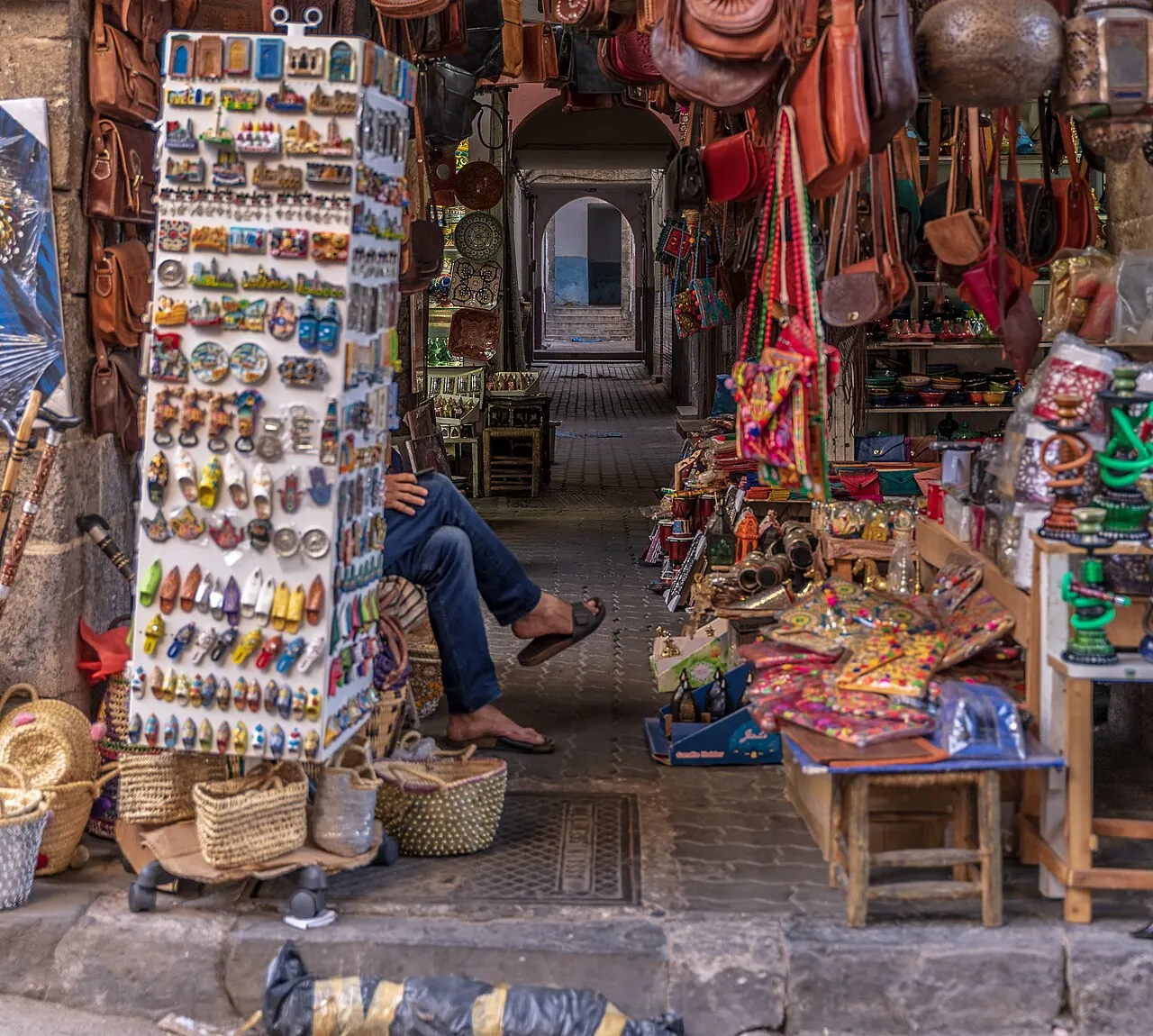

Casablanca is not Morocco's main craft city, and much of what you see in its shops is made elsewhere in the country, or outside it. That makes it worth knowing what you are looking at. This page covers where to buy crafts in the city, from the Quartier Habous to a fixed-price craft centre, the old medina and the Marché Central; what is genuinely Moroccan-made; how to buy argan oil, ceramics, leather, babouches, rugs, spices and tea sets; and how to get them home. For the markets themselves, and for designer shopping, see our markets and luxury shopping guides. We take no commission from any shop.
Casablanca souvenirs, what to buy and where
The Quartier Habous
Where to shop. The Habous, the 'new medina', is the calmest place in the city to shop for crafts. Iberia Club calls it a mecca for crafts and antiques, with handmade plates, tagines and mosaics, leather goods, caftans, djellabas, carpets and tablecloths. Journey Beyond Travel notes pottery brought in from Fez and Safi, handwoven carpets from across the country and many booksellers, and describes prices there as more or less fixed, without the high-pressure selling of other medinas (2019, so check). Iberia Club names Maison Poterie Serghini, a ceramics house with a showroom in the city. Our Quartier Habous guide covers the arcades, the olive stalls and the pastry shops.
A fixed-price craft centre
Where to shop. If you would rather not haggle at all, World Travel Guide lists the Exposition Nationale d'Artisanat at 3 Avenue Hassan II, selling crafts at fixed prices. GPSmyCity describes it as spread over three floors, with carpets, leather goods, jewellery, brass work and ceramics such as tagines. Neither source is dated, so check it is still trading before you go. Many Moroccan cities also have a state-run Ensemble Artisanal with fixed prices (Insight Guides); we have not found a current one in Casablanca, so do not plan around it.
The old medina and the Marché Central
Where to shop. The old medina by the port is still full of stalls selling trinkets and fresh food, and is far less touristy than the souks of Marrakech (World Travel Guide). It is better for a wander and small gifts than for serious craft buying. The Marché Central on Boulevard Mohammed V sells some souvenirs and handicrafts alongside its food (World Travel Guide), and is a good stop for spices, teas, honey, olives and oils (Iberia Club). Derb Ghallef is a market for locals rather than a souvenir stop. Our markets and souks guide covers all three in detail.
Moroccan-made or imported?
Know what you buy. World Travel Guide rates the city's craft ware, carpets and leather as good quality, but says to check you are buying the genuine article rather than a cheap imitation. Some things are not what they seem: Indagare, writing about a glassworks in Marrakech, says Moroccan tea glasses were once all made by hand in Morocco but that most glasses in the souk today were made in China. We have not checked how far that holds in Casablanca, so ask. For leather, MWN Lifestyle's rule is that anything that looks as if it came off an assembly line and smells of plastic probably is not the real thing. Ask where an item was made and by whom; a seller who knows will tell you without hesitating.
Argan oil
What to buy. The argan tree grows in south-west Morocco, mainly in the region between Essaouira and Agadir, and much of the oil is made by women's cooperatives (Wikipedia; WIPO). Oil for cooking is pressed from roasted kernels; oil for skin and hair is a separate product, so know which you want. Dilution is a real problem: Wikipedia reports oil cut with sunflower oil and Moroccan export checks for purity, and in a 2020 study by the Quadram Institute four of 28 products sold as pure argan oil failed an authentication test. Telling a diluted oil by smell or feel is not reliable, as the study needed laboratory analysis. Buy sealed, labelled bottles that name the producer or cooperative, from a shop you trust rather than a street stall. Morocco applied to the EU in 2011 to protect the name as a geographical indication (WIPO); check whether that has since been granted.
Ceramics and tagines
What to buy. Much of the pottery sold in the Habous comes from Fez and Safi (Journey Beyond Travel): Fez is known for cobalt-blue hand-painted ceramics, and Safi for earthy glazed ware (MWN Lifestyle). MWN Lifestyle points out that a decorative tagine is a safer souvenir than a cooking one; if you do want to cook in it, ask the seller whether it is made for the stove. Wrap pieces well and carry the fragile ones in your hand luggage.
Leather and babouches
What to buy. Babouches are Moroccan leather slippers, usually with a soft sole and in a wide range of colours (Pommie Travels). Leather goods are sold in the Habous and at the fixed-price craft centre. Good leather has an earthy smell and small natural marks, so a flawless, plastic-smelling finish is a warning sign (MWN Lifestyle). Look at the stitching and the sole before you buy, and try slippers on before you pay.
Rugs, without the pressure
What to buy. Rug buying in Morocco often comes with mint tea and a long show of carpets, and the sales talk is part of it; one buyer's account describes the moment she stood up to leave as the moment the price moved (A Side of Sweet, 2013). Decide before you go in what size and colours you want, take your time, and remember that accepting tea does not oblige you to buy. Ask who made the rug and where. The Habous has carpets from across the country with a calmer style of selling (Journey Beyond Travel), and the fixed-price craft centre sells them without haggling. MWN Lifestyle notes that rug cooperatives, especially in the Atlas, tend to price more transparently than souvenir shops.
Spices, tea and tea sets
What to buy. For spices, follow Iberia Club's advice and buy them whole rather than ground: they stay fresher and keep more flavour. The Marché Central sells saffron, cumin, turmeric and other spices, as well as teas. A Moroccan tea set usually means a metal teapot, small glasses and a tray, often engraved (Pommie Travels). If you want glasses made in Morocco rather than imported, ask: one Marrakech-based source says most souk glasses are now made in China (Indagare).
Haggling, and fair prices
Practical. Most goods in the souks and markets are not priced, and sellers expect you to haggle (World Travel Guide). Insight Guides' advice: only start if you mean to buy, do not show how much you like the item, open low, stay polite, and thank the seller and walk away if the price is too high. Look around two or three shops before buying anything large, so you know what is fair. If you would rather not bargain, look for fixed-price signs or use a fixed-price craft centre. And do not tell a taxi driver you are going craft shopping, as some take you to shops that pay them. Our journal piece on how to haggle in the souks has the details.
Packing argan oil and other liquids
Getting it home. Oils count as liquids at airport security. At most UK airports, liquids in hand luggage must be in containers of 100ml or less, even if the container is only part full, and some airports ask for them in a single clear bag; rules differ from airport to airport, so check those at your departure airport, any transit airport and your return (GOV.UK). We have not confirmed the current rule at Casablanca's Mohammed V airport, so check with your airline. The simple answer is to pack larger bottles of argan oil, honey or olive oil in your checked bag, sealed and wrapped in a plastic bag.
Shipping rugs and customs
Getting it home. A rug rolls up smaller than you would expect: one buyer had hers sewn tightly into thick plastic and checked it in as hold luggage (A Side of Sweet, 2013). For larger pieces, MWN Lifestyle says most reputable sellers can arrange shipping; get the delivery terms, insurance and a receipt in writing before you pay. GOV.UK warns that Morocco has strict rules on goods taken into or out of the country and that you must declare anything that may be prohibited or subject to duty; see the Moroccan customs website. If you buy anything sold as old or antique, ask the seller about export paperwork and check with customs. Going to the US? Its customs restrict imports of some Moroccan archaeological and ethnological material unless documents show it left Morocco legally (Federal Register, January 2026); the rule covers genuinely old pieces, from before 1912, not new crafts. Your home country's own allowances apply when you land.
Shopping on a private day with us
Booking. We can fit the Habous, the old medina or the Marché Central into a private city tour, with your driver taking you between them and your bags kept in the car. We take no commission from shops and sell no shop stops, so where you stop is up to you. Tell us your dates.
Want to shop with a driver?
We fit the Habous, the old medina or the Marché Central into a private city tour, with your bags kept in the car. We take no commission from shops. Tell us your date and group, and you get the plan and a fixed price in writing within 24 hours.
Sources
- Journey Beyond Travel: Casablanca's Habous Quarter (21 Jan 2019)
- Iberia Club: shopping in Casablanca (Mar 2025)
- World Travel Guide: shopping in Casablanca
- GPSmyCity: Exposition Nationale d'Artisanat, Casablanca (undated)
- Insight Guides: Morocco, how to haggle (21 Aug 2019)
- Indagare: Beldi Verre, on Moroccan tea glasses
- Pommie Travels: souvenirs from Morocco (31 Mar 2026)
- MWN Lifestyle: your essential guide to shopping Morocco's souks (23 Jul 2026)
- Wikipedia: Argan oil
- WIPO: protecting society and the environment with a geographical indication (argan oil)
- Quadram Institute: argan oil adulteration uncovered (8 Apr 2020)
- A Side of Sweet: buying carpets in Morocco (30 Dec 2013)
- GOV.UK: hand luggage restrictions, liquids
- GOV.UK: Morocco travel advice, entry requirements (customs)
- US Federal Register: extension of import restrictions on Moroccan archaeological and ethnological material (14 Jan 2026)